

Contents
- What is digital marketing?
- Reaching your customers with digital marketing
- Why use digital marketing?
- 1. measurability – see results and gauge how successful a campaign is
- 2. cost – digital marketing is cheaper
- 3. reach – it’s easier to reach more people and businesses
- 4. greater precision – reach exactly the people or businesses who could become your customers
- 5. it becomes easier for small and new businesses to compete with bigger players
- 6. digital marketing is adaptable
- 7. online marketing boosts conversion rates
- What does it take to succeed with digital marketing?
- 1. the customer journey
- 2. recognition
- 3. ongoing measurement and evaluation
- 4. access to the right expertise
- Types of digital marketing
- 1. search engine optimization (seo)
- 2. content marketing
- 3. pay-per-click (ppc)
- 4. social media marketing
- 5. affiliate marketing
- 6. native advertising and sponsored content
- 7. email marketing
- 8. online pr
- 9. instant messaging marketing
- Other strategies
- What does a digital marketer do?
- A digital marketer measures results
- Hiring an expert
- Types of digital marketers
- Content marketing specialist
- Seo specialist
- Social media manager
- How do you do digital marketing?
- 1. form a hypothesis about the customer journey
- 2. set goals for each stage of the customer journey
- 3. choose the marketing that best supports your customer journey and goals
- 4. allocate a budget
- 5. set up a way to measure results
- 6. kick off the project
- 7. fine-tune your marketing
- 8. invest in tools that help you measure and improve the customer journey
- 9. branding
- 10. increase the budget
- Looking for help with digital marketing?
What is digital marketing?
Digital marketing is about reaching customers through digital channels and platforms, primarily online. It covers strategies such as search engine optimization (SEO) on Google, advertising through digital media, social media marketing and email campaigns. By using these methods, businesses can build genuine relationships with both existing and prospective customers. In this guide, you’ll learn how to use digital marketing to boost your visibility and reach your business goals.
In simple terms, digital marketing is just “marketing” – with the one proviso that it happens digitally, online and through digital channels.
Reaching your customers with digital marketing
In marketing generally, it’s all about reaching the right audience with the right offer at the right time. That classic rule holds just as true online.
Chances are, all – or at least most – of your customers are online today. That means you need a way to reach them digitally, over the internet. But digital marketing isn’t just a necessity; it’s an opportunity too. It lets you tailor your offers, measure results more accurately, follow up, adapt and refine your campaigns. You can reach exactly the right audience with fewer resources, saving both time and money. That’s why it’s often far more effective than traditional marketing.
In this guide, we’ll cover what digital marketing is, why it’s worth doing, and the various types of online marketing available. We’ll also look at who carries it out, how, and what it takes to succeed. On top of that, you’ll find plenty of concrete examples to help you think through different aspects of online marketing and get started.
Why use digital marketing?
Here’s a list of good reasons to invest in digital marketing:
- Measurability: It’s easier to measure than traditional marketing.
- Cost: Digital marketing is cheaper than traditional methods.
- Reach: You can reach more people and businesses.
- Greater precision: You can easily target exactly the people and businesses most likely to become your customers.
- Adaptability: It’s quicker and easier to tweak your marketing strategy when everything is digital.
- Better conversion rates: Online marketing can improve your conversion rate – not just online, but through traditional channels too.
Let’s take a closer look at each of these.
1. Measurability – see results and gauge how successful a campaign is
One of the biggest challenges with traditional marketing is that results are hard to measure. How do you know a particular campaign actually worked? With digital marketing, that problem disappears.
Online, you can measure almost everything that happens and analyse the entire chain of events. You can then use that information to refine your campaigns and get even better results. In other words, it’s much easier to measure ROI with digital marketing.
Here’s a concrete example:
- A newspaper advert (non-digital): You can measure how many copies were distributed and sold, but you have no way of knowing how many people actually saw the advert or how many contacted the business or bought a product or service as a result.
- An online advert or article (digital marketing): You can measure exactly how many times the advert or article was shown. You can see how many people clicked on it, how many read your article and for how long, how many bounced straight back, and how many clicked through to something else. You can measure whether advert A converts better than advert B, whether a red button outperforms a green one, and so on. In short, you can measure absolutely everything.
There are several ways to measure how well your online marketing is performing. Here are some of the most common metrics:
- Website visitors: See how many visitors your site and its individual pages attract, and which digital marketing channel each one came from.
- Impressions: See how many times an online advert has been shown.
- Click-through rate: How many people clicked through — on an advert, a pop-up or an email, for example.
- Open rate: See how many people opened an email.
- Conversion rate: What proportion of visitors buy a product or service?
- Time on page: Measure how long each visitor stays on a given page.
- Pages per visitor: Do your visitors read just one article, or several pages?
- Likes and shares: How is the response on social media platforms such as Instagram, TikTok and Facebook?
- User behaviour: See how visitors move around your website and identify obstacles and bottlenecks — with a tool like Hotjar, for example.
2. Cost – digital marketing is cheaper
Digital marketing is the polar opposite of throwing money away. It’s an effective way for businesses to reach their customers with minimal spend and maximum precision.
Because you can measure everything, it’s easy to spot a channel or campaign that isn’t pulling its weight. You can then stop investing in it, or work out how to make it profitable instead. Conversely, you can see which methods perform best and put more budget behind those. Full visibility over your data gives you full control over how your money is spent.
Here’s an example:
One digital channel might be organic traffic from Google, driven by SEO. Another could be Instagram. A third might be paid adverts through Google Ads.
With digital marketing, you can track exactly how much you’ve spent on each channel — how much has gone into content and SEO, for example, or into hiring a designer for your Instagram content. You can see precisely what you’re paying for your digital adverts, and how much direct sales each channel has generated. That makes it easy to work out the ROI for every single channel.
You might notice that visitors coming via Google generate a lot of sales relative to what you’ve invested, or that only a certain type of paid advert delivers a good ROI. Armed with that, you can fine-tune your strategy to become even more profitable – and your cost per customer will fall over time.
Thanks to this measurability, the constant improvements it enables, and the fact that everything happens electronically, digital marketing is usually cheaper than traditional marketing.
3. Reach – it’s easier to reach more people and businesses
Digital marketing isn’t tied down by physical limits the way traditional channels are. All it takes is a product or service that someone, somewhere, might be interested in – and the ability to deliver it there – for digital marketing to pay off. Reaching a new geographical area, whether within Sweden or abroad, costs you nothing extra.
Traditional marketing is a different story. There’s always a barrier to entering a new region, and if you’re advertising abroad, finding the right channel can get genuinely complicated. Online, you can start reaching new areas quickly – and just as quickly pull out of the ones that don’t prove profitable.
4. Greater precision – reach exactly the people or businesses who could become your customers
Digital marketing lets you target exactly the people or businesses most likely to convert into customers. That’s a huge difference from traditional marketing. Advertise via posters, newspapers, TV or radio, and you have very little control over who actually sees, hears or absorbs the message. Sure, you can choose to advertise in a particular neighbourhood where you expect plenty of potential buyers, or alongside a TV programme your audience might watch – but it’s still a fairly blunt instrument.
Digital marketing, on the other hand, lets a business define exactly which audience it wants to reach. Messages can even be tailored so that two different people see two different adverts – all to maximise conversions and make the marketing more cost-effective.
Social media, for instance, lets you reach people based on age, gender, location, interests and behaviour. Website adverts can be tailored so visitors only see content relevant to their interests. You can even target across channels – capturing data from users who land on your site via Google Ads or organic search, then building targeted Facebook campaigns around them. This is really what precision in digital marketing comes down to: a set of tools that help you understand your audience better, so you can keep refining your marketing and making it more effective.
5. It becomes easier for small and new businesses to compete with bigger players
How can a relatively small, young business stand a chance against established giants with marketing budgets running into the millions? Digital marketing opens up a host of exciting new possibilities.
Here are a couple of examples:
A search engine doesn’t care whether a large multinational or a tiny startup is behind a given article — what matters is the quality of the content. With relatively modest resources, your content marketing can produce material that matches your audience’s interests and brings in plenty of new customers.
Perhaps you run a blog that attracts thousands of visitors a month. You can invite those visitors to sign up to your newsletter, then send out regular emails at almost no cost beyond the time you or your team put in.
6. Digital marketing is adaptable
Granted, a campaign sometimes needs time to bear fruit. But other times you’ll realise quite quickly that something wasn’t quite right. Mistakes happen, and it helps to be able to fix them fast – and digital marketing is far more flexible than traditional channels in that respect.
If you’ve booked direct mail or a newspaper advert, the lead times involved in preparation and contracts make it hard to change course at the last minute. With online marketing, though, you can literally just hit pause – saving you both time and money.
7. Online marketing boosts conversion rates
Because it’s so easy to measure everything in digital marketing, you can pinpoint exactly what converts well. A high conversion rate matters because it means you need fewer resources to achieve the same result – and it’s a competitive advantage in its own right.
You could, for example, use Google Optimize to run A/B tests and find out which headline engages visitors best, or whether a green button converts better than a red one, and so on.
Digital marketing can also lift your overall conversion rate. If you consistently show up as a trustworthy source in Google’s organic results, people become more likely to buy from you – regardless of which channel the sale actually happens through, including the “real”, physical world. People turn to Google for information, and a constant presence there makes buying from you feel that much safer.
What does it take to succeed with digital marketing?
Digital marketing has plenty of advantages over traditional marketing, but it’s also highly complex. It’s a far cry from pressing a button and waiting for the results to roll in.
Here are four key factors for success:
- Understand the customer journey
- Build recognition
- Measure and evaluate continuously
- Have access to the right expertise
1. The customer journey
Every customer, online or off, goes on a “journey” – whether it’s a seven-year-old buying an ice cream or a business procuring complex services over the internet. Understanding, or wanting to understand, what that journey looks like is a precondition for succeeding with digital marketing.
Why does it matter so much? Understanding the customer journey lets you shape your online marketing to hit the mark – grasping how prospective customers think and what they need, then adapting accordingly.
It’s also essential for avoiding gaps in your digital marketing. If you only market at the very start and the very end of the journey, you’ll lose plenty of customers along the way.
2. Recognition
It helps enormously if people already recognise your company and brand. People are simply more likely to engage with businesses and brands they know.
This chart shows just how important a brand is for search engine optimization.
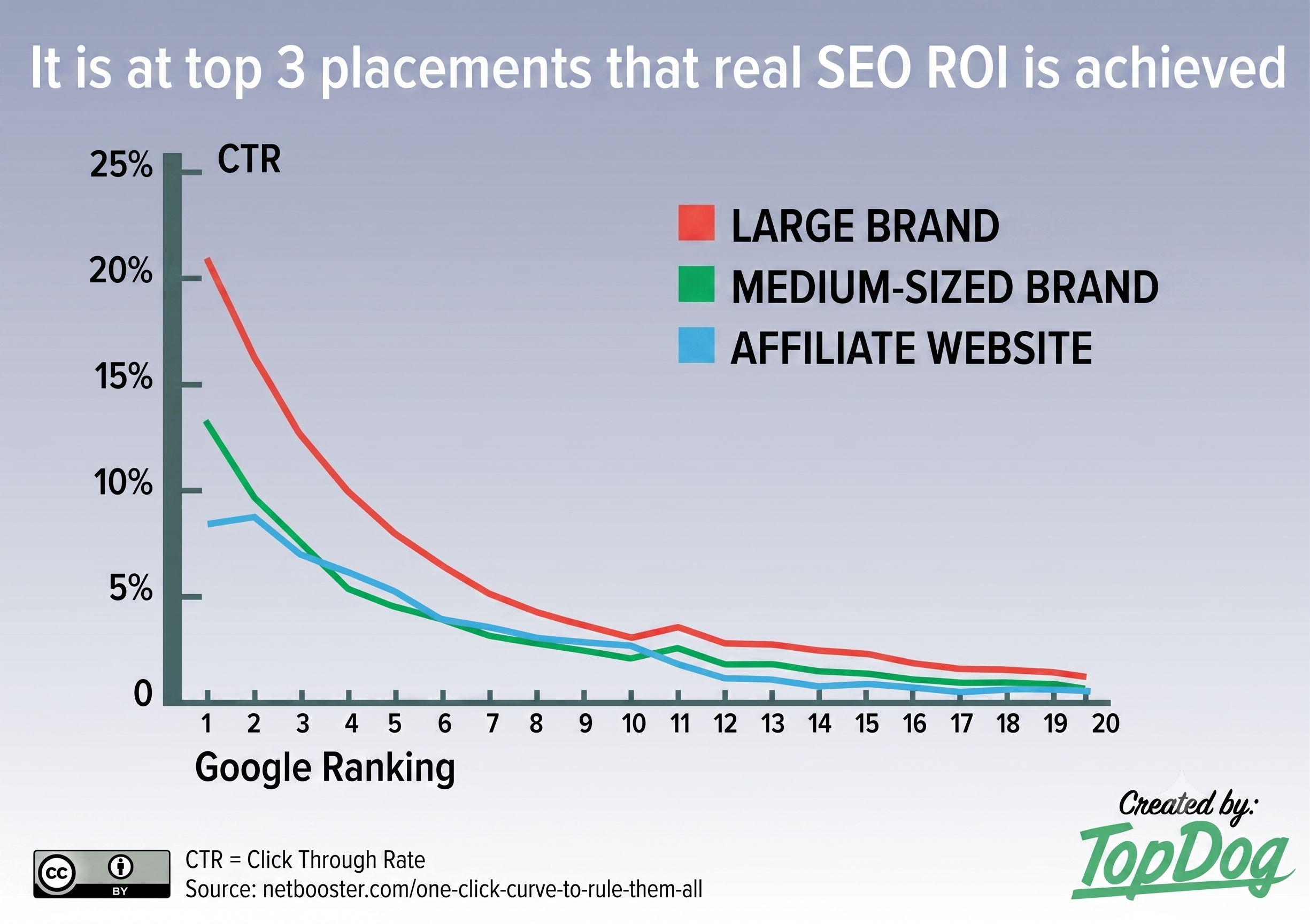
We’re not talking about achieving Coca-Cola or Starbucks-level recognition — that’s obviously not realistic. It’s more about reaching a point where your specific audience thinks “this feels familiar” the moment they land on your site.
How do you get people to recognise your business? There are many ways, but at its core it comes down to branding – building a strong brand and making sure as much of your target audience as possible recognises it. This naturally extends beyond the digital world and can just as easily involve traditional channels like TV, radio, direct mail and print.
One of the most effective online tactics is publishing genuinely useful content that answers the questions people are searching for. Base your articles on thorough keyword research, and your business will keep popping up in relevant searches whenever someone Googles for answers. Display adverts, too, help build brand awareness.
Another approach is maintaining a regular presence through paid adverts. These two tactics reinforce each other, too, driving down your overall advertising costs. Staying active on social media – Instagram, Facebook, TikTok – or publishing videos on YouTube also builds recognition, as does running a newsletter.
3. Ongoing measurement and evaluation
One of the most valuable things about digital marketing is the ability to measure it. This is where point 1, the customer journey, comes back into play. Once you have a clear picture of that journey, you can measure every step, from a customer’s first contact with your marketing right through to the purchase – or, taking an even longer view, right through to their second, third or fourth purchase.
With digital marketing, you don’t have to guess. Make the most of the chance to gather data at every stage of your online marketing, then find an efficient way to evaluate what it tells you.
Finally, use those results to fine-tune your campaigns – and, if necessary, your wider strategy.
4. Access to the right expertise
Succeeding with digital marketing means having access to the right expertise – and an organisation built to support it.
There’s no shortage of agencies and freelancers promising to boost your sales through SEO, Google Ads, Facebook Ads and the rest. Unfortunately, far from all of them are genuinely up to the task, so choose your experts carefully. You’ll also need to make sure your organisation has the capacity to absorb the project. Digital marketing is complex, and every successful project draws on a mix of external and in-house expertise.
Types of digital marketing
Digital marketing takes many different forms, and most businesses run several channels in parallel to maximise their impact.
Here’s a rundown of the main types of online marketing:
- Search engine optimization (SEO)
- Content marketing
- Pay-per-click (PPC)
- Social media marketing
- Affiliate marketing
- Native advertising and sponsored content
- Email marketing
- Online PR
- Instant messaging marketing
Let’s dive into each of these.
1. Search engine optimization (SEO)
Search engine optimization (SEO) is the practice of carrying out a range of activities so that a website and its content rank higher in search engines – and, as a result, attract more organic visitors.
Within digital marketing, SEO is something of a magic wand — capable of improving everything from Google Ads to email marketing. Crucially, it also brings in visitors who are genuinely interested in learning something, and those visitors can turn into excellent customers, now or later on.
SEO really deserves a guide of its own, here you can read our complete guide and get help with search engine optimization. In short, though, it involves creating content, building links, and improving the technical side and user experience of your site.
2. Content marketing
Content marketing is a core part of digital marketing and the single most important component of on-page SEO. It means creating content according to a well-thought-out plan, with the aim of attracting visitors and building brand awareness, leads and, ultimately, more customers.
Here are some concrete examples of what content marketing can involve:
- Blog: Writing about topics that answer your customers’ questions and demonstrate the expertise they expect from you.
- Video: Producing videos that engage viewers by explaining how something works.
- Podcasts: Building a loyal following through regular episodes on topics your audience cares about.
- Ebooks: Offering visitors something extra, such as a genuinely useful ebook, in exchange for a newsletter sign-up.
- Infographics: Bringing an article’s content to life through engaging visuals.
3. Pay-per-click (PPC)
Many businesses rely on pay-per-click (PPC) advertising as a core part of their online marketing. This type of marketing also goes by the name Search Engine Marketing (SEM).
Unlike SEO, the results – in the form of new visitors – arrive immediately. But unlike SEO, they only last as long as you keep paying.
The price per click is usually decided by an open auction, so it fluctuates depending on how many competitors are bidding on similar keywords at any given time.
Adverts can appear in a variety of places across several different networks, including:
- Google Shopping
- Search results on Google and other search engines
- Other websites
- Apps
Tip: you can cut your Google Ads spend through optimization.
4. Social media marketing
Most people use some form of social media today. Since Facebook launched, a whole wave of new platforms – Instagram, LinkedIn, Pinterest, TikTok, Snapchat – has followed.
Audience and content vary from platform to platform, so there’s rarely much point trying to be everywhere at once. Focus on the platforms that matter most to you.
Social media can support your digital marketing simply by raising awareness of your brand. It doesn’t even have to be advertising – sharing interesting content, joining in discussions, and being available to answer customer questions all count.
If a piece of content goes viral, that’s obviously a jackpot in terms of publicity and new customers. But going viral is by no means a requirement for your social media marketing to count as a success.
5. Affiliate marketing
Affiliate marketing means paying someone a commission to sell your products or services – either a fixed fee per lead or sale, or a percentage of the total order value. It’s a way of gaining new customers while someone else handles the actual marketing.
In practice, traffic is tracked using a unique link. A blogger or influencer might recommend a product or service you sell, and whenever someone clicks their link or uses a specific discount code, the commission is logged.
Affiliates rely heavily on SEO to attract visitors. Others use paid advertising – such as Comparison Shopping Services (CSS) – or social media to generate leads.
You gain a new customer, and your affiliate earns a reward for their trouble – which keeps them motivated to bring in more leads.
6. Native advertising and sponsored content
Native advertising is a form of sponsored content – typically an article-style advert designed to blend in with the surrounding editorial content. You’ll spot native adverts on news sites and blogs, among other places. Other forms of sponsored content include mentions on social media or in YouTube videos.
7. Email marketing
Email marketing is often underrated. It has the advantage of being virtually free, and it’s a great way to make the most of a contact you’ve already made – which is exactly why email remains such an effective tool online.
Here are a few examples of what email marketing can look like:
- Newsletters
- Follow-up sequences after someone downloads an ebook
- Welcome emails for new customers
- Offers for existing customers
It’s worth noting that email marketing is not the same thing as spam – it relies on only emailing people who’ve opted in and shown an interest one way or another.
8. Online PR
Public relations works online just as it does offline. Through outreach, you can strengthen your brand, build trust with visitors and boost the effectiveness of your other digital marketing channels.
What kind of PR can you do online? Here are a few examples:
- Earn positive reviews: Ask customers to review you on Google My Business, Trustpilot, Prisjakt and other rating sites.
- Ask for testimonials: Feature quotes from some of your best customers about your product, service or company on your site.
- Product reviews: If you run an e-commerce business, encourage customers to rate the products they’ve bought.
- Interviews: Take part in interviews for YouTube features and podcasts.
9. Instant messaging marketing
Finally, there’s instant messaging marketing – through apps like WhatsApp, Facebook Messenger or Viber. It works much like search engine advertising, except the advert appears inside a phone app rather than among search results.
Other strategies
The types of digital marketing above can be approached in different ways, and are often combined.
Automation is a common way of making online marketing more efficient – for example, triggering an email sequence when someone signs up to your newsletter, or scheduling social media posts to publish automatically.
Inbound marketing flips the script, getting customers to come to you rather than the other way round. It’s about attracting, inspiring and engaging customers rather than pushing a hard sell. In digital marketing terms, that might mean publishing genuinely useful content instead of blasting out adverts, or sending an engaging newsletter to people who’ve opted in – rather than firing off indiscriminate emails, in other words, spam.
Both automation and inbound marketing can be applied across most digital marketing channels.

What does a digital marketer do?
A digital marketer is responsible for growing brand awareness and the number of leads a company generates through its digital channels. That might involve boosting visibility on Google through the company blog and SEO, managing paid PPC campaigns, running social media accounts, or handling the company newsletter.
Plenty of different specialists work in digital marketing in one way or another. Some focus on just one or two aspects of online marketing; others try to cover most of them. Very few handle every aspect, and virtually no one does all of it effectively.
A digital marketer measures results
As we’ve mentioned, measurement and follow-up sit at the heart of digital marketing. That’s why marketers track a set of KPIs over time to gauge how well a channel or campaign is performing.
Exactly which KPIs matter depends on the channel. For SEO, the number of organic visitors is a key metric, along with rankings for specific keywords, perhaps.
For Google Ads, relevant KPIs might include the number of clicks, click-through rate, cost per click and ROAS (return on ad spend).
For social media, useful KPIs might be follower count, likes, shares or inbound enquiries.
Hiring an expert
Some businesses choose to handle their own online marketing, but it often pays to bring in an expert — whether that’s an external agency or a new hire. Their knowledge and experience is usually worth paying for, compared with learning through costly trial and error yourself.
Types of digital marketers
What a digital marketer actually does depends heavily on the type of role we’re talking about. Here are a few examples:
Content marketing specialist
Area of responsibility:
Responsible for the company’s content — blog posts, information pages and product descriptions, as well as video.
Reports to: Usually the marketing manager.
Example KPIs:
- Blog visitors
- Average time per article
- Page views per visitor
- New email subscribers
- Social media followers
- YouTube subscribers
- Occasionally, conversions to sales or leads
Example activities:
- Preparing a content strategy and content plan
- Content analysis
- Coordinating input from different departments
- Coordinating writers and other content production
- Editing, proofreading, publishing and internal linking
- Follow-up and reporting
SEO specialist
Area of responsibility:
An SEO specialist is responsible for getting the company’s website to rank highly for relevant search terms on Google and other search engines, with the goal of increasing site traffic. They work closely with — or are sometimes directly responsible for — the people producing the site’s content.
Reports to: Usually the marketing manager, but sometimes the CTO.
Example KPIs:
- Organic visitors
- Average time per page
- Pages per visitor
- Google rankings
- Ranking and visibility on Google
Example activities:
- Planning content that drives traffic
- UX
- Technical SEO
- Link building
- Tracking search engine performance (rank tracking)
- Reporting
Social media manager
Area of responsibility:
Manages one or more social networks on the company’s behalf, including planning, producing and publishing content. The role also involves interacting on the platform to boost visibility, answer questions and capture leads.
Reports to: Usually the marketing manager.
Example KPIs:
- Followers
- Shares
- Likes
- Feed impressions
- Enquiries
Example activities:
- Building a content strategy and planning content
- Publishing posts on a regular schedule
- Responding to questions from other users
- Engaging on the platform
- Capturing leads and forwarding enquiries
- Creating tailored content for specific channels
How do you do digital marketing?
So how do you actually get started with online marketing? Digital marketing is a complex process that demands strategy and careful planning, followed by systematic execution, evaluation and follow-up.
Here’s a step-by-step approach to rolling out digital marketing in your business:
- Form a hypothesis about the customer journey
- Set goals for each stage of the journey
- Choose the marketing that best supports that journey and those goals
- Allocate a budget
- Set up a way to measure results
- Kick off the project
- Fine-tune your marketing
- Invest in tools that help you measure and improve the customer journey
- Focus on branding
- Increase the budget
Let’s look at each step in more detail.
1. Form a hypothesis about the customer journey
The first step is forming a hypothesis about the customer journey. If you sell screwdrivers, for instance, your hypothesis might look something like this:
- The customer Googles “best screwdriver” to learn more, finding the answer in your company’s blog post, an online magazine or an affiliate site.
- The customer lands on your category page for screwdrivers, or a specific product page — arriving via organic Google search, Google Ads, affiliate marketing or a comparison site like Prisjakt or PriceRunner.
- Some visitors buy straight away; others keep browsing and thinking it over. Along the way, some sign up to your newsletter via a form on the blog or in the shop.
- Some of those newsletter subscribers eventually take up an offer and buy the screwdriver, or another product.
The hypothesis might be that it takes an average of two to three touchpoints across different channels before a sale happens. If you sold cars instead of screwdrivers, the hypothesis would need to include a visit to a showroom and a couple of test drives before conversion.
Different products and services, in other words, call for different hypotheses about the customer journey.
2. Set goals for each stage of the customer journey
Once you’ve sketched out a hypothesis for the customer journey, it’s time to set goals for each stage of it.
Going back to the example above, that might mean writing three blog posts about screwdrivers and getting them to rank well for a chosen set of keywords.
You might also need well-written category and product copy to attract Google traffic and convert visitors.
One goal might be getting at least three affiliates to promote your screwdriver. Another could be ranking among the three best prices on comparison sites. A third might be hitting a specific visitor target through Google Ads.
3. Choose the marketing that best supports your customer journey and goals
It’s rarely worthwhile — or effective — to pursue every form of digital marketing at once. The Pareto principle, the 80/20 rule, often applies here too.
That 80% of your results usually comes down to SEO and Google Ads. The two also complement each other, forming a powerful combination for driving high volumes of well-converting traffic.
Once you’ve made the most of those, it might be time to branch out and explore other channels.
4. Allocate a budget
Think of digital marketing as an investment: the money you put in should generate a return. With that in mind, it’s worth setting a clear budget so you know exactly what you have to work with. It’ll help you keep your marketing focused and set realistic goals.
5. Set up a way to measure results
As we’ve said, measurement is central to digital marketing, and Google Analytics will take you a long way — letting you see traffic and trace it back to different channels. You can also track conversions, so you know which adverts or campaigns are delivering the best results.
For SEO, Google Search Console and various SEO tools are invaluable — our own favourite is Ahrefs. You can read more about different SEO tools here.
How you measure things can also depend on the channel. You might track the success of your email campaigns directly through the analytics built into your email platform, for example.
6. Kick off the project
With a plan, a budget and a way to measure results in place, it’s time for kick-off. You’ll need the right people on board — will you be running the digital marketing yourself, has someone else been put in charge, or have you brought in an external expert?
You’ll likely need to involve one or more members of staff who can support whoever’s leading the project with information and input. If the website needs changes, IT or an external web agency will need to get involved too.
Kick-off is also the right moment to brief management on what to expect. Since you’ve framed digital marketing as an investment, management will naturally expect to see results down the line.
7. Fine-tune your marketing
You’ll rarely get it completely right the first time. Treat your digital marketing as a process you can keep adjusting and improving until it runs the way you intended.
As long as you’re measuring the right things, you’ll get feedback on what’s working and what isn’t. If one part of the customer journey seems to be sticking, dig into what might be causing it.
You might find your Google Ads budget was far too generous while your SEO could use more investment — in which case, it’s time to rebalance.
While fine-tuning your marketing, it’s also worth looking at how it connects with offline activity. If your company advertises in newspapers or on TV, how does that show up in your online results — and are there synergies to be found?
8. Invest in tools that help you measure and improve the customer journey
You’ll probably also find that additional tools can give you an even clearer picture of how your digital marketing is performing — and help you improve it further. There’s no shortage of options.
- Ahrefs, mentioned earlier, is great for keyword research and link building, among other things.
- Hotjar is excellent for understanding the user experience on your site.
- Google Optimize helps you A/B test content to, for example, improve conversions.
- Optimizely is a platform for improving a website’s user experience.
9. Branding
People generally prefer to buy from businesses that feel familiar, because familiarity creates a sense of security. A brand can stand for certain values — stated, implied or simply assumed — whether that’s quality, trustworthiness, proven products, heritage, and so on.
Investing in branding — how your company is presented and perceived — increases the chances that visitors form the right impression of it, which in turn helps traffic from your digital channels convert well.
10. Increase the budget
Once you can see your digital marketing paying off, it’s time to increase the budget. As long as it remains profitable and the business can keep up with demand, there’s no reason to hold back.
That said, returns always taper off eventually — you can’t keep scaling the budget forever.
With PPC advertising, the market itself sets the limit on how far you can push your budget. Once a visitor has seen your advert a certain number of times, each additional exposure delivers diminishing returns — which is why ROAS tends to fall as you keep increasing spend.
Looking for help with digital marketing?
Topdog is a small, specialist agency whose core expertise sits at the intersection of business, change management and digital marketing. If that’s the kind of online marketing partner you’re looking for, we could well be a good match. Feel free to get in touch with Christian for advice on 0708 140833 or via [email protected].