

Contents
- What is ai seo?
- Why is it important to optimize for ai search?
- Ai seo vs traditional seo
- Three types of ai seo: geo, aeo and llmo
- How does ai seo work?
- A deeper look at ai seo and how an llm works
- Writing for ai
- Technical seo for ai seo
- What others say about your brand online matters for ai seo
- How to optimize for chatgpt
- How to be seen in google ai overviews and ai mode
- Strategy for ai search optimization
- Ai seo for e-commerce
- Other aspects of ai seo online retailers need to consider
- Tools for ai seo
- The problem with ai seo
- Measuring ai seo
- Why choose topdog for ai seo?
What is AI SEO?
AI SEO is the practice of optimizing a brand’s visibility in AI-powered search tools such as ChatGPT, Google AI Mode, Google AI Overviews, Perplexity and Claude. Traditional SEO is about ranking in a list of links; AI SEO is about shaping how AI assistants perceive, summarize and cite information about your brand – so that you become part of the answer itself, not just a link beside it.
AI SEO also goes by names such as AI optimization, AI search optimization, or “optimization for AI search”. Three related concepts describe different parts of the work – GEO, AEO and LLMO – which we’ll cover further down the page.
Why is it important to optimize for AI search?
Investing in AI SEO helps brands protect their reputation, boost their share of voice and drive measurable business growth from platforms that send millions of visitors your way. Being a source AI trusts means future-proofing your digital presence in a landscape where answers are the new currency. The way we search for information is changing fundamentally, and businesses that fail to adapt risk becoming invisible once AI agents start recommending products and services.
AI SEO vs traditional SEO
The key difference is this: traditional SEO is about ranking highly in a list of results, while AI SEO is about shaping what the AI search engine actually says and recommends. Your position no longer decides the outcome – what matters now is whether you appear in the answer at all, and what it says about you. Three things have fundamentally changed:
1. Users are asking longer, more conditional questions
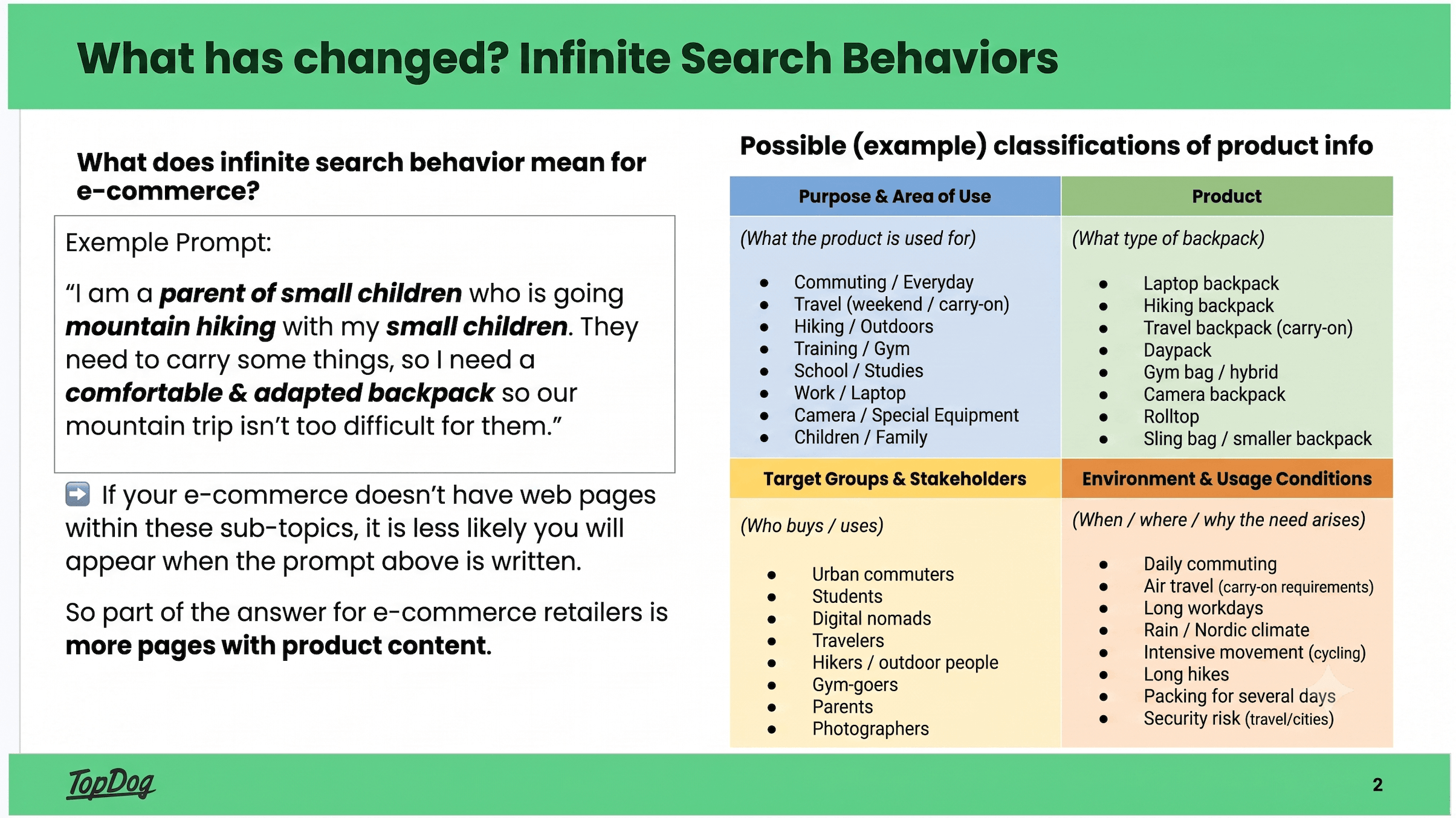
People used to search for single keywords like “kids’ hiking backpack”. Now they spell out their whole need in one query: “backpack suitable for kids, for hiking, that’s also cheap“. In B2B, it might sound more like “SEO agency with good client reviews, strong e-commerce experience and solid technical skills“. These queries are packed with conditions and combinations, and that changes how you need to build your site. Structure and content need to reflect these layered needs, rather than being optimized for a single keyword such as “e-commerce SEO agency”.
2. It’s about influence – not ranking
In AI search, positions 1 to 10 don’t matter; what counts is what the AI search engine actually says about your company. That’s why your brand has become so much more important. Your brand also needs to appear in the models’ training data – otherwise the AI is left guessing, and it may end up presenting the wrong picture of you altogether. Actively shaping what’s said, and making sure the right information sits where AI goes to find it, is the very core of AI SEO.
3. The AI tools are still immature – and that’s an opportunity
AI search engines are currently pretty poor at filtering out noise, which means there’s a lot of spam around – particularly in ChatGPT. That will almost certainly change over time, at least if ChatGPT is serious about becoming a genuine search tool. Right now, though, there’s a clear head start on offer for brands that work in a structured, trustworthy way today.
In summary – how AI SEO differs from traditional SEO:
| Traditional SEO | AI SEO |
| Ranking in a list of links | Influencing and appearing in AI-generated answers |
| Single keywords (“kids’ hiking backpack”) | Complex, conditional questions (“…for kids, for hiking, cheap”) |
| Position decides the outcome | What AI says about your brand decides the outcome |
| Links and on-page optimization in focus | Brand, mentions and training data in focus |
| The same results list every time | Probabilistic — the answer varies |
Differences between conventional SEO and AI SEO, simplified
Three types of AI SEO: GEO, AEO and LLMO
Three terms are used in AI optimization to describe different parts of the work. They overlap, but each has its own focus:
- GEO – Generative Engine Optimization: Optimizing content so it becomes a chosen source in the generative summaries AI engines produce, such as Google AI Overviews. Read more about GEO
- AEO – Answer Engine Optimization: Maximizing visibility in AI chatbots and voice assistants by delivering direct, verifiable answers to specific questions. Read more about AEO
- LLMO – Large Language Model Optimization: Making sure your brand’s information becomes a lasting part of the knowledge that language models (LLMs) are trained on and refer back to.
In practice, most work covers all three at once – they’re simply different ways of influencing the same thing: appearing, and being represented accurately, in AI-generated answers. AI SEO is probably the best umbrella term for all of this right now.
How does AI SEO work?
AI SEO rests on three pillars: technology, content, and what others say about you. Together, these determine how AI engines read, interpret and choose to cite information about your brand.
- Technical clarity: You optimize your site’s structure and use schema markup so AI engines can easily read, interpret and cite your content. It’s essential that an AI search engine can access and crawl your content in the first place.
- Content AI wants to cite: You create authoritative content that answers users’ questions comprehensively, so the AI engine chooses your content as its source.
- What others say about your brand: AI tools also factor in what others say about you online, and build their picture of your brand from that.
We’ll cover each pillar in more detail further down the page – from the technical foundations to how you influence what others say about you.
A deeper look at AI SEO and how an LLM works
A language model (LLM) doesn’t work like a traditional search engine that retrieves a ready-made list of links. Instead, it predicts the most likely answer based on patterns in the data it was trained on, supplementing this with live searches when needed. That’s why both what sits in the model’s training data, and what’s being said about you online, determine how your brand comes across in the answer.
Writing for AI
Content is at the heart of AI SEO. For an AI model to choose your content over anyone else’s, it needs to be both readable – easy for the machine to parse – and worth citing: credible and comprehensive. Here’s how to write for AI:
Write using the pyramid principle. This is the foundation: pose a question or statement as your heading, then answer it directly in the first sentence before going into more depth. AI models rarely read whole articles – they scan for short, clear chunks of information they can lift out and cite. Give them the answer right under a clear heading, and you improve your odds of being the one they choose.
Make your content easy to “pull chunks” from. AI models favour clearly delineated formats that can be lifted out and reproduced on their own. Prioritize:
- Short, standalone paragraphs that make sense on their own
- Headings phrased as the actual questions customers ask
- Lists and tables – easy formats for a machine to parse and reproduce
- Clear quotes and concept definitions – self-contained chunks ready to lift into an AI answer
- “Best of” formats and comparisons (e.g. “best X for Y”) – the kind of round-up that’s often cited directly in AI answers
Write with genuine authority. AI models assess whether content was created by someone with real experience and actual knowledge. So don’t write a generic guide – write about how your brand solves the problem, drawing on your own insights, data, case studies and methods.
Be data-driven and close content gaps. Work out where good answers are missing in your industry – for example, by looking at citations in AI answers or your own support conversations – then create content that fills those gaps. A competitor comparison will show you where rivals are picking up citations you’re missing out on, so you can claim that visibility for yourself.
A word of caution about “chunking”. Breaking content into standalone “chunks” – small, self-contained blocks of text that AI can easily lift out – has become a popular way to write for AI. Taken too far, though, the result reads as choppy and almost unreadable for an ordinary visitor. And that’s where you miss the whole point: a human who can’t be bothered to read won’t convert. Write for AI, but never at the expense of readability and conversion – the best content works for machine and human alike.
Technical SEO for AI SEO
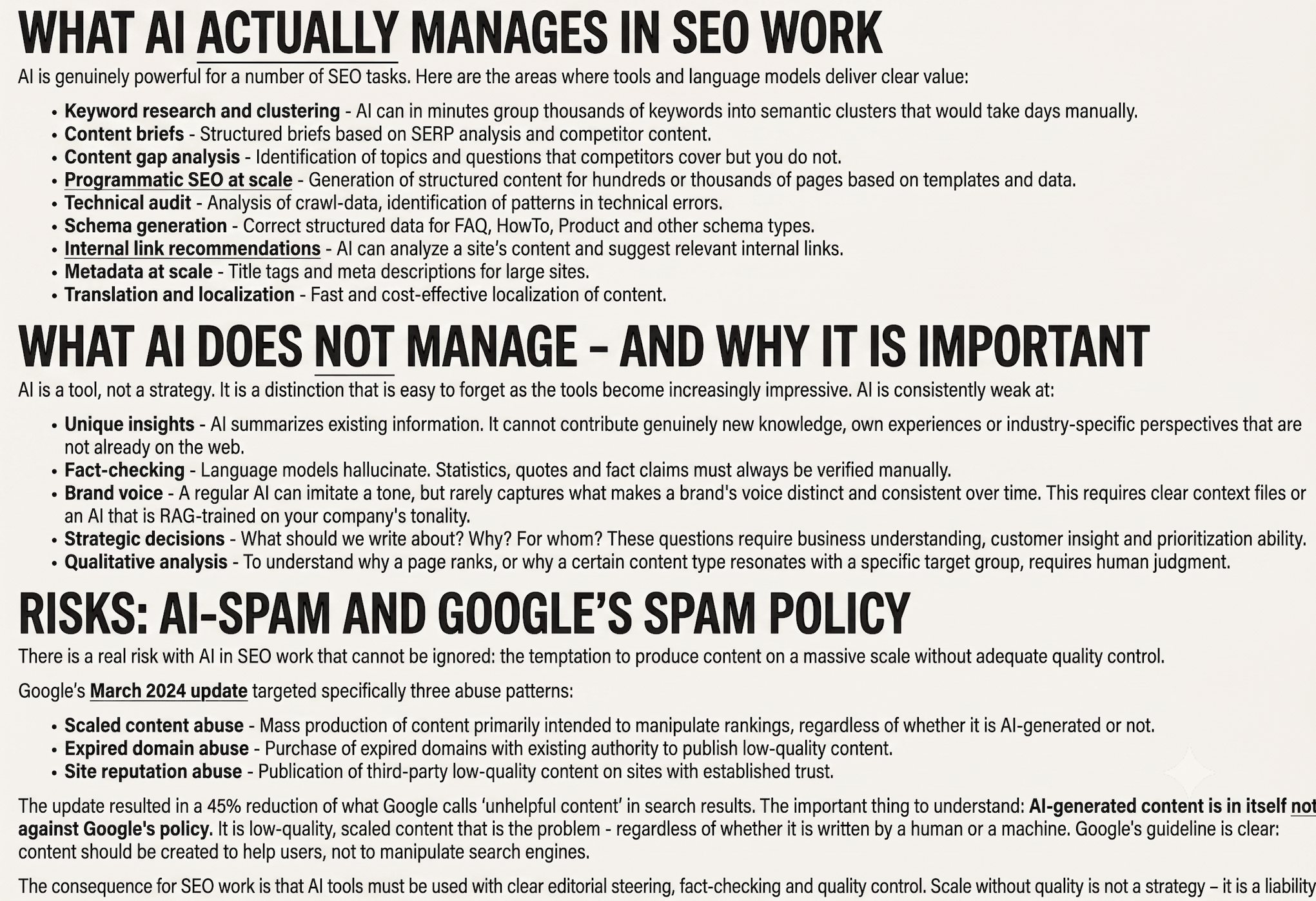
Technical SEO lays the groundwork for all AI optimization – without a technically healthy site, your AI visibility has nothing to anchor itself to. This part of AI SEO is, for the most part, identical to conventional SEO: it’s about removing anything that stops machines from understanding your site.
The most important technical factors to optimize:
- Accessibility for AI crawlers: Make sure your robots.txt and server aren’t blocking AI bots – GPTBot (OpenAI), ClaudeBot (Anthropic), PerplexityBot and Google-Extended, for example. If the models can’t read your site, they can’t cite it.
- JavaScript rendering: Many AI crawlers struggle with heavy JavaScript. Make sure your key content sits in the static HTML source, whether through server-side rendering or dynamic rendering.
- Schema markup (structured data): Helps AI place your site in the right context. Use relevant schemas such as Article, Product, FAQPage and HowTo, and connect entities using properties like code class=”bg-text-200/5 border border-0.5 border-border-300 text-danger-000 whitespace-pre-wrap rounded-[0.4rem] px-1 py-px text-[0.9rem]”>mentions,
aboutandsameAsto clarify the relationships between brands, people and concepts. - llms.txt (contested): A proposed file intended to guide AI models to your most important content. Its value is debated – Google itself has said the file doesn’t affect how it treats your site, even though some of its own checking tools still look for it. Our take for now: low priority, but cheap enough to add if you want to stay ahead of the curve.
- Core Web Vitals and performance: Speed and stability still matter. Benchmarks to aim for: LCP under 2.5s, CLS under 0.1 and INP under 200ms.
- Semantic HTML and heading hierarchy: A logical H1–H3 structure helps AI gauge the relevance of your content. This is where the technical side of “Writing for AI” comes in.
- Site hierarchy and internal links: Build a main page with relevant subpages and link them together using descriptive anchor text, so AI can see the depth of your expertise.
- XML sitemaps: Keep them up to date so AI bots can quickly find your priority and most recently updated content.
What others say about your brand online matters for AI SEO
Other people’s content matters too in AI SEO. If you want your brand to show up in searches for “best xyz”, for instance, credible third-party websites need to be saying so about you.
That’s why mentions, awards, product reviews, influencer content and digital PR all carry weight in AI SEO. AI systems gather this information and use it to form an overall assessment, which they then present to whoever’s searching. But there are two pitfalls that make ongoing monitoring especially important:
The training data can be out of date. Models are trained on vast amounts of old web content – sometimes pages dating back to the 1990s and 2000s – and form their view of the world from that. That means AI can describe your company, your products or an entire category based on facts that were once true but no longer hold up. One example: in a widely discussed test by AI SEO agency DEJAN, Dan Petrovic asked Claude for help choosing webinar software, and the model claimed YouTube couldn’t do screen sharing without extra software like OBS. That was true several years ago – it’s wrong today. The outdated “fact” had simply stuck around in the training data.
Negative and biased information colours the picture. Poor reviews – as well as information from competitors and partners – shape how AI sees you, and it’s sometimes skewed deliberately for commercial reasons. In that same test, affiliate-driven and competitor-driven “best webinar tools” lists steered the model away from the obvious free option (YouTube), because the sources AI pulled from had every incentive to rank their own products higher. The AI passed that bias along as if it were neutral advice.
Monitoring what’s being said about your brand is therefore a core part of AI SEO. Tools like Ahrefs and Semrush let you track, in real time, how your brand is mentioned and cited in AI engines such as ChatGPT, Claude, Perplexity and Google AI Overviews – spotting inaccuracies to correct and gaps where you can get accurate, up-to-date information in front of AI. Think of it as the AI-era equivalent of link building in traditional SEO.
How to optimize for ChatGPT
ChatGPT builds its answers from two sources: what’s in the model’s training data, and what it retrieves live through search (largely Bing). Optimizing for ChatGPT means being present – and being represented accurately – in both. Here are the factors that matter most:
Understand the two sources. The training data is what the model “already knows”, and it’s rarely updated. Live search fills in with fresh information. Long-term authority shapes the former; searchable, up-to-date content shapes the latter – you need both.
Bing is your way in. ChatGPT’s live search relies heavily on Bing. If you’re not visible on Bing (top 10–20), your chances of being cited drop dramatically. Set up Bing Webmaster Tools and keep an eye on your visibility there.
Let ChatGPT’s bots in. Allow GPTBot (training) and OAI-SearchBot (live search) in your robots.txt – otherwise ChatGPT can neither learn about you nor pull you up live.
Three things that, in our experience, stand out specifically for ChatGPT:
- Its American/English lens. ChatGPT leans heavily on English-language, often American, sources. If you’re not particularly well known and only have a Swedish-language site – a local business, say – visibility can be hard to come by. Often, though not always, you’ll need an English version of your site to make an impact. It’s counter-intuitive, but ChatGPT’s “world view” is fundamentally American.
- Its sensitivity to lists on other sites. ChatGPT is unusually responsive to lists and round-ups on external pages (“best X” lists, comparisons). Appearing in these – and appearing near the top – has a big influence on whether and how you get recommended.
- Reviews and “best of” content for products. For products, reviews and “best of” content carry serious weight. This holds true for other LLMs too, but the effect is particularly pronounced with ChatGPT – make sure other sites carry credible “best of” content about your products.
Make your own content citable. The pyramid principle, short paragraphs, FAQs and schema all make it easy for ChatGPT to lift out and cite you. (More on this under “Writing for AI”.)
Keep your facts consistent. The same details about you everywhere (sameAs, uniform company information) reduce the risk of ChatGPT guessing wrong or confusing you with someone else.
ChatGPT Shopping. For e-commerce, a product feed in Microsoft Merchant Center improves your chances of appearing in ChatGPT’s shopping answers. (More on this in the e-commerce section.)
Monitor your presence. Track how you’re mentioned and cited in ChatGPT using Waikay, Morningscore or Ahrefs Brand Radar.
How to be seen in Google AI Overviews and AI Mode
Unlike ChatGPT, Google AI Overviews and AI Mode draw on Google’s own search index and your regular organic ranking – not Bing. That means classic SEO is the very foundation for appearing here. Here’s how to improve your odds of being chosen and cited:
Strong organic ranking is the foundation. AI Overviews and AI Mode draw heavily on pages that already rank highly in organic search. If you’re at the top for the relevant keywords, you’re also a likely source for the AI answer — so keep doing “regular” SEO, it’s the prerequisite for everything else.
Answer like a featured snippet. Google favours content that answers the question directly. Put the question in your heading and give the answer in the first sentence, following the pyramid principle, so Google can easily lift it out and display it in an AI Overview.
Build topical authority and demonstrate E-E-A-T. Google chooses AI Overview sources it trusts. Cover the topic comprehensively and demonstrate real expertise and first-hand experience – shallow content is rarely cited.
Adapt for AI Mode and “query fan-out”. AI Mode breaks a complex question down into many sub-questions, searches for each one, and weaves the results into a combined answer. To be visible, you need to cover the whole topic and its sub-questions within a coherent topic cluster — not just optimize a single page for a single keyword, as we describe under AI SEO vs traditional SEO.
Use structured data. Schema such as FAQPage, HowTo and Product helps Google understand and surface your content in generative answers. We cover how to work with schema under Technical SEO for AI SEO.
Let Google-Extended in. Allow Google’s AI crawler, Google-Extended, in your robots.txt so your content can be used in AI Overviews and AI Mode — more on crawler access under Technical SEO for AI SEO.
Measure your presence. Track which keywords trigger AI Overviews and whether you appear in them, for example with Morningscore’s AI Overviews tracker or Semrush. See Tools for AI SEO and Measuring AI SEO.
Strategy for AI search optimization
The most important strategic goal is turning your own website into the most reliable source of information about your business. If you don’t publish clear facts about what you do and who you are, AI systems are left guessing, or piecing together information from random corners of the internet. That’s when the summaries AI shows – the kind ChatGPT produces, for example – start containing errors, and you lose leads as a result.
That’s why a core part of any AI SEO strategy is having the right content, communicated the right way. It starts with an up-to-date brand guide covering detailed information about customers, target audiences, personas, positioning, and the situations you want to be visible in.
The brand guide then becomes the reference point for everything else: it shapes the content on your own website, what you want said about you on other people’s pages, and the rest of your communications. The point is consistency – making sure the same, accurate picture of your brand shows up everywhere AI goes looking for information.
An example: if you’re the best at something, both you and your reviewers need to say so. When your own site, your reviews and your mentions all tell the same story, that story becomes the “truth” AI repeats back.
AI SEO for e-commerce
For online retailers, AI search is changing the very way products get discovered. Instead of short keywords, users are now typing complex, need-based prompts – and classic category pages simply can’t keep up. You need a website that mirrors user intent at a far more granular level.
- It’s mainly a data problem, not just a content one. Product data needs to be structured and detailed enough to scale.
- Build out your site around intent. More pages, filters and content covering different purposes, audiences, use cases and situations.
- Supporting content carries real weight. Tests, reviews and guides help AI judge relevance.
- The conditions vary by industry. In some niches, content outweighs product data.
- The winners build flexibly and at scale. Many online retailers aren’t ready yet, often held back by duplicate content and weak structure.
Other aspects of AI SEO online retailers need to consider
- Make sure your product and company facts are correct across the web
One of the biggest risks for online retailers is AI services spreading inaccurate information. If you sell complex products – computers, say – and the AI has its facts wrong, users’ detailed searches and spec-related questions get answered incorrectly, and that costs you sales. AI often builds its “opinions” from what’s written on external sites, in catalogues and in reviews.
What to do: Monitor what information ChatGPT retrieves about you, and correct any inaccuracies at the external source. Clean up broken links (404 pages) too — if AI tries to pull information from a product category and hits a 404, it can’t formulate an answer or recommend you at all.
- Connect Microsoft Merchant Center
Since ChatGPT often uses Bing’s API to pull current information in real time, integrating with Microsoft’s ecosystem is critical. Many online retailers focus solely on Google Merchant Center, but in the AI era, Microsoft’s equivalent matters just as much.
What to do: Create and optimize a product feed in Microsoft Merchant Center. Doing so dramatically improves the odds of your products showing up when AI services present shopping results.
- Think in “topics” rather than keywords, and be comprehensive
When AI tools map out the world, they do it as topic clusters. To be seen as the most relevant source, your store needs to cover your niche comprehensively – think of it as writing a book with every chapter included.
What to do: If you sell washing machines, a transactional category page for “buy washing machine” isn’t enough on its own. You also need in-depth, easily digestible content on “washing machine error codes”, “installation” and similar aspects of the topic if you want AI to rank you as an authority.
- Implement structured data and collect reviews
AI services use reviews to shape what they present as “facts” about your brand or your products.
What to do: Use structured data (schema markup), particularly for reviews. This makes it far easier for AI services to understand your site’s content and pick up on what customers are saying about you.
- Ranking on Bing is your ticket into ChatGPT
Put simply, “ChatGPT search is Bing search”. If information about your products or campaigns is new and hasn’t made it into the AI’s training data, it’ll go and google – or rather, bing – it instead.
What to do: Set up Bing Webmaster Tools. If you’re not in the top 10 or 20 on Bing for a given topic, your chances of being recommended when ChatGPT runs a live search drop sharply.
Tools for AI SEO
At Topdog, an AI SEO agency, we use four tools for AI SEO – Ahrefs, Semrush, Morningscore and Waikay. We rely on several because AI answers are probabilistic: you won’t always show up, and the answer won’t always look the same twice. Each tool captures its own slice of reality, and only by combining them do you get a reliable picture of where things stand. That’s also what makes AI SEO more resource-intensive than conventional SEO.
Here’s how we use each one:
- Ahrefs– the backbone for keyword, competitor and link data. We use Brand Radar to track how a brand is mentioned and cited in AI answers, which matters because what others say about you shapes how AI portrays you.
- Semrush – broad keyword and competitive data, plus AI tracking, including how you show up in Google AI Overviews. Good for cross-checking Ahrefs and spotting gaps.
- Morningscore – a more user-friendly, Nordic tool that tracks AI Overviews and ChatGPT mentions daily, complete with sentiment and source insights. We use it for a quick visual overview, which is especially valuable for the Swedish market and for clients who want reporting that’s easy to digest.
- Waikay – short for “What AI Knows About You”. It tracks a brand across multiple AI models and hundreds of prompts, measures share of voice, and flags inaccuracies (hallucinations) that need correcting.
Since no single tool gives you the full picture in the world of AI, we combine them to triangulate our way to the truth.
The problem with AI SEO
The biggest challenge in AI SEO is the lack of reliable data on how people actually search. Unlike Google, which gives you Search Console, tools such as ChatGPT and Gemini offer no equivalent window into user behaviour. That means, when we build strategies, we’re largely left guessing at what search behaviour actually looks like.
The most common workaround illustrates the problem well: Semrush and other tools offer “prompt research” data, much like keyword research in conventional SEO. But that data is fundamentally built on assumptions – ordinary keyword data has simply been run through AI and converted into questions. There’s nothing wrong with using it, but it’s worth remembering that it rests on guesswork whenever you’re drawing conclusions about actual behaviour.
So today, there’s simply no definitive user-behaviour data to work from. You can’t get it through Google Ads either, and it’s unlikely ChatGPT will offer it going forward. In all likelihood, we’ll be guessing our way forward for quite some time yet.
Measuring AI SEO
Measuring AI SEO happens on two levels: actual business outcomes in GA4, and AI visibility within the tools themselves.
The most objective measure is Google Analytics (GA4). It shows you the real impact – where traffic is coming from (referral sources), which content is performing well, how much traffic AI sources are driving, and, most importantly, goal completions and conversions. This is where you find out whether AI SEO is actually generating business.
The second level is AI visibility itself – how often, and how, your brand is mentioned and cited in AI answers. You measure that inside one of the tools we covered earlier (Ahrefs Brand Radar, Semrush, Morningscore or Waikay). Bear in mind that AI answers are probabilistic – these tools show you fragments rather than the whole truth, but they do give you a direction of travel and let you track progress over time.
Why choose Topdog for AI SEO?
We hope this article has given you a clearer picture of what AI SEO is and how to approach the AI SEO process. If you feel you need help putting AI SEO into practice on your website and within your organization, Topdog is an excellent choice.