





Need help with e-commerce SEO?
-
 Get in touch
Contact Topdog for more information about e-commerce SEO.
-
Meeting
We'll set up a meeting to talk through how we can help.
-
Analysis
Topdog carries out an analysis based on your specific situation.
-
Proposal
Topdog puts together a project and cost proposal.


Topdog is a specialist SEO agency for e-commerce, helping ambitious online retailers win market share through organic visibility. We treat SEO as a business tool rather than a traffic exercise — one where technology, content, UX and site structure all work together to drive sales, not just clicks.
As an SEO agency working in e-commerce, we focus on execution and measurable impact. Our senior SEO specialists analyse, prioritise and drive the work forward together with you — no middlemen, no generic templates. The goal is simple: more commercial landing pages, better rankings for purchase-intent keywords, and an online store that turns organic traffic into revenue.
Why choose Topdog for e-commerce SEO?
- Topdog brings genuine seniority and expertise. Every SEO consultant at Topdog working on e-commerce has over ten years’ experience in technical and e-commerce SEO.
- You work directly with the SEO expert — there’s no project manager or account handler standing between you and the work.
- We bring a personal commitment that goes beyond the norm.
- Topdog follows a clear process for delivery. Planning matters to us.
- We’re strong at project management. That’s what creates lasting change in your online business.
- Topdog is exceptionally good at e-commerce SEO.
- We’re skilled at adapting to each client’s circumstances — for instance, we can tailor a project specifically to you.
- Planning is something we take seriously, and it shows.
- For online retailers, SEO and conversion are one and the same — and that’s exactly how we set project goals.
What does search engine optimization mean for e-commerce?
E-commerce SEO is technical SEO combined with UX and conversion work. That’s because an online retailer’s real content isn’t text — it’s the products themselves. Technology is what makes those products relevant to Google, consistently and at scale. Take a product database of 20,000 items: you simply can’t manage that manually. It has to be handled through technology and user experience. E-commerce SEO is therefore largely about how products are structured across the site or webshop.
What do e-commerce SEO problems actually look like?
The challenge for online retailers is that they have thousands of products that all need to be made relevant to Google’s users. Put simply, an e-commerce business wants to rank for a huge number of different search terms.
Ranking higher in Google means working with e-commerce’s core content: the product database. You do that through technical solutions and UX — the territory technical SEO usually covers. In practice, e-commerce SEO tends to become a genuinely complex process, one where technology, user experience and content all have to work in sync.
Getting your e-commerce SEO right means making all these pieces fit together. That takes serious technical know-how — both to put together clear requirements for the development team, and to build a process that ensures every improvement actually gets implemented alongside them.
What e-commerce businesses need to succeed with SEO in 2026
- Insight – if you don’t understand what needs improving, nothing changes.
- Budget – what internal and external resources will it take to get the impact you’re after?
- Clear goals – the project’s direction has to be spelled out. Will you focus on filters, categories, brand pages, product pages? Which product types? In short: which opportunity do you want to go after?
- Feedback – management wants to know how the project is progressing, which problems are proving hardest to crack, and what impact the work is having.
- Adaptability – every company is different. As your partner, we adapt to your budget, pace, resources and technical constraints.
- A shared process – the SEO team and the development team need one shared process, or fixes and improvements simply won’t make it onto the live site.
How does Topdog approach e-commerce SEO?
Topdog’s optimization process for online retailers is primarily technical, though UX plays an important part too. The process runs in two stages — planning and execution — and for execution, we work within a shared agile process.
1. Planning your e-commerce SEO
At Topdog, we start by putting together a plan (an SEO strategy) that answers the following questions:
- What needs to be done?
- How should it be done?
- Who will do it?
- When should it happen?
- What are the goals?
- What are the risks?
- What resources are needed?
The point of this planning stage is to build a shared understanding of what needs doing, how, and why. That way, we can build a clear picture of the project together and work out the best way to collaborate. This is also where we take on board feedback and insight from your development team and management — it’s essential that the development team has a say if the project is going to succeed. Good collaboration, and a real understanding of your business, is what makes SEO work in practice.
Beyond this, a clear delivery process between Topdog and your e-commerce development team is essential. Topdog works within your existing agile process to drive the SEO project forward.
2. Delivering e-commerce SEO
At this stage, we use your development team’s existing agile process to carry out the planned actions. Throughout the project, our SEO consultants continuously check the work being delivered and document its impact. When the goal is getting Google to rank thousands of products and hundreds of categories, every detail has to be exactly right.
Example of what an execution plan might look like for an online retailer
The image shows an example of technical planning built in Jira. Each row represents a technical ticket within an agile process.
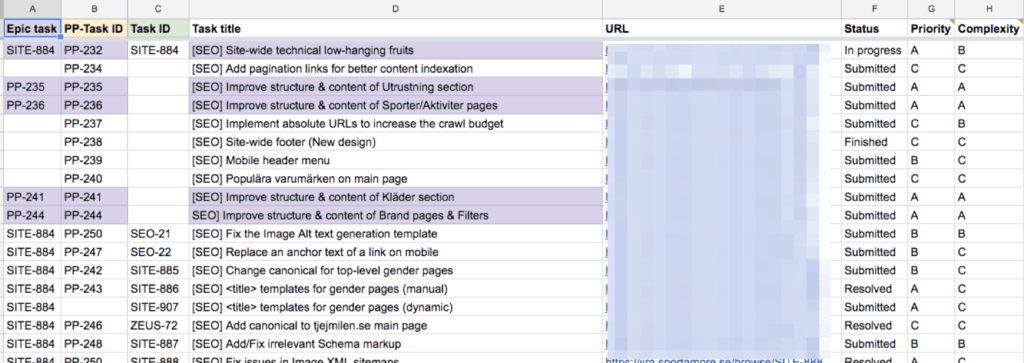 This is what technical planning can look like when we run SEO for e-commerce clients.
E-commerce and AI SEO
For an online retailer, AI SEO is about becoming as relevant as possible to specific searches — or prompts. The underlying problem is the same as with traditional e-commerce SEO, just on a much bigger scale. The range of different search types within an AI search engine is far wider than on standard Google. That means you’ll need to scale up your product content dramatically to stay relevant across as many of those situations as possible.
The main obstacle here is the product database. It needs better classification to reflect different use cases and situations.
The solution, unsurprisingly, involves using AI to reclassify every product, then applying technical SEO and UX to scale up the size of your online store.
Want to understand e-commerce SEO problems better?
Find e-commerce SEO hard to get your head around? In the video “SEO for E-commerce,” Christian discusses what e-commerce SEO actually is, how to think about it, the most common problems retailers run into, and how to solve them together with your SEO agency.
Common problems in e-commerce SEO
Most online retailers wrestle with similar SEO problems. Here’s a look at the most common issues holding online stores back.
Duplicate content
If your URL structure includes product categories and subcategories in the path, you risk creating duplicate content — copies of the same content living at more than one URL. Google doesn’t like that.
Example:
store.com/category/subcategory/product.html
store.com/home-appliances/kitchen-machines/toaster.html
store.com/home-appliances/electrical-equipment/toaster.html
Since you want to reach both people interested in kitchen machines and people interested in electrical equipment, you’ve placed the product in both categories. That may well make sense from an e-commerce point of view, but Google reads it as two different products with identical content.
The fix
There are two ways to solve this:
- Place your products directly under the root of the site rather than inside a folder in the URL. Within the store itself, they can still sit in a category — what matters is that every path or URL is unique for each product. Example: store.com/amphibious-bus.html
- Tell Google that only one of the products actually exists. The simplest way is with a canonical tag. Adding a canonical tag tells Google which page is the original. This isn’t always entirely foolproof, though, so to be on the safe side, we’d recommend giving every product a unique path directly under the root of the site (as above).
Filtering, sorting and pagination
In most cases, both customers and retailers want the option to filter and sort products — by colour or price, for example. That creates multiple versions of the same content. Filtering and sorting sometimes generate entirely new paths too, which makes things even trickier. Pagination — where content spreads across multiple pages — can cause similar problems.
The fix
This, too, can be solved in two ways:
- Make sure filtering and sorting don’t generate unique paths (URLs). This approach often has the added benefit of boosting traffic from Google, though it’s technically complex to implement.
- Use a canonical tag.
Product copy
Another common problem for online retailers is product copy. With large product ranges, many retailers skip writing unique text for every product simply because it’s expensive to do.
The fix
The result is duplicate content. There’s no easy fix, since duplicate content is often perfectly acceptable in many cases. One approach is to focus on creating a more distinctive, better user experience rather than writing fresh copy. Another is to use AI to scale up the production of unique, relevant product content.
Here’s what you’ll need:
- Strong, clickable titles and descriptions
- An accurate, persuasive H1
- Simple navigation — buying, browsing and finding the information you need before purchase should all be effortless
- Compelling offers
- Relevant content that earns links from other sites
Why hire Topdog for e-commerce SEO?
We offer:
- A safe, clearly defined process for e-commerce SEO
- Clear technical project planning
- A close fit with your development team
- Genuine interest in you as a client
- Work shaped around your circumstances
- Delivery alongside you that produces results
Our services related to e-commerce SEO






Our clients









Reviews
 5/5
5/5
In our two content projects with Topdog, the collaboration has worked very smoothly. Topdog has been flexible and adapted both content and work process to our goals, while being responsive to changes and new conditions during the course of the projects.
Topdog is clear in their communication, takes responsibility for delivery and drives the work forward in a way that creates security for us as customers. They are committed, proactive and often contribute more than expected, which makes them more than just a supplier.
We experience Topdog as a reliable SEO partner who is easy to work with and who understands both our needs and the commercial context. We at Biltema can recommend Topdog to other e-tailers

Johan Gerdevåg
Marknadschef
Biltema
5/5
We at Dearsam have had the privilege of working with Topdog and we are very pleased with the result.
Topdog has really made sure that the collaboration works in practice – from the first planning meeting to ongoing deliveries, they have taken responsibility and ensured that things happen. When new information or technical limitations arose, they have shown great flexibility and adaptability, which meant that the project never stopped but flowed smoothly.
We also appreciate that Topdog follows up continuously – they make sure that we both understand what is happening and that we reach the goals we set. In addition, they have been nice, considerate and genuinely interested in our business – it has felt like a collaboration, not just a customer-supplier relationship. Isabelle, who has been in charge, has been a rock.
For us, it goes without saying: all e-retailers should hire Topdog if they want both technical expertise, business focus, and a partner who truly cares about driving results.”
Mats Ohlsson
Grundare & VD
Dear Sam
5/5
We at Fotoklok had the pleasure of collaborating with Topdog on a UX SEO project, and the results have been positive. Despite the fact that the project was not an easy one, Vova & Pontus at Topdog showed impressive energy, adaptability and focus throughout the entire process.
Topdog’s work has had a significant impact on our e-commerce sales. Their understanding of both SEO, e-commerce and user experience has helped us optimize our website in a way that really makes a difference.
We appreciate Topdog’s commitment and recommend Topdog to other companies and e-commerce stores that want to take their digital presence to the next level!
Thomas Hammarström
VD & Grundare
Fotoklok
5/5
Topdog has been a great partner in improving our local SEO. Their team is knowledgeable, engaged, and understands what it takes to rank for competitive local searches. Since working with them, we’ve seen a clear improvement in our visibility, leading to more relevant leads and ranking on lower funnel search terms. They are also easy to work with—proactive, responsive, and focused on results.
After working with them on a local project they provided a full site audit that was used to make other SEO updates to improve customer experience and rankings. I have requested input from the Top Dog team multiple times even after the contract was completed and they were more than willing to assist. I would highly recommend them to any business looking to strengthen their local search presence.
Haley Damron
Marketing Director
American Pest
5/5
What I appreciated most about our collaboration with Topdog was their tremendous dedication – they were always available, responsive, and took the time to answer all my questions. Topdog’s team has a way of explaining e-commerce SEO that makes it easy to understand, without feeling technically overwhelming. They were also with us every step of the journey, which made the collaboration both reassuring and inspiring.
We warmly recommend Topdog to anyone looking for an SEO partner for their e-commerce, who not only knows their field, but also takes the time to truly get involved.
Said Alhmidi
Bobby Hair Care
5/5
We at eKompass hired Topdog to assist our e-commerce client with a complex website migration, where the site needed to be split into two parts after a company sale. Topdog acted quickly and adapted to our existing technical processes and the client’s needs. Their professionalism and efficient working methodology made the project successful and the collaboration easy. I can highly recommend Topdog to other e-commerce clients.
Göran Joelsson
Senior eCommerce Consultant
eKompass
5/5
Topdog is the SEO agency I recommend! Their deep knowledge of SEO and their structured implementation process mean that we at Wallism get the effect we want in Google. I especially appreciate their flexible working methods and how well their processes adapt to our technical processes.
In addition to their technical expertise, Topdog stands out through their commitment to us as a customer – they really care about our results and long-term success.
Joakim Friedman
Founder & CEO
Wallism
5/5
Topdog is an excellent partner for us at Mjuk. Mjuk is a marketplace where the assortment changes every day, and Topdog has shown great commitment by adapting their work to our specific needs and challenges. With a flexible and clear process, they have helped us improve both our e-commerce SEO and our content. The results have been impressive, especially considering that the first project was of a smaller scale. We also appreciate their cool attitude and focus on results and look forward to continuing the collaboration.
Max Heino
Co-founder & CEO
Mjuk
5/5
We at Holistic have had the privilege of collaborating with Topdog to improve our SEO for our e-commerce and our internal processes, and we are more than satisfied with the results.
Topdog has from the start ensured that we understood what needs to be done, set up goals and then translated them into actions for our organisation or for Topdog. This has led to significant improvements in traffic and sales through Google.
Topdog’s strategies are well thought-out and tailored to our specific needs. They have shown a great ability to adapt to our internal processes and changing circumstances.
Their dedication also exceeded our expectations. Topdog has truly gone “the extra mile” to help us reach our business goals, and their work has had a clear impact on our digital sales.
We warmly recommend Topdog to all companies looking for a reliable, generous and results-driven partner in e-commerce SEO.
Daniel Kostic
Head of digital
Holistic
5/5
We at Sorselestugan have had the pleasure of collaborating with Topdog to improve our UX SEO, conversion and expand our website in Google. The collaboration has exceeded expectations from the first contact where we listened to one of Topdog’s webinars on e-commerce to the final evaluation meeting.
Topdog has shown an extraordinary commitment during the project. They have a strong focus on results and follow up on all efforts in detail to ensure that the goals are met. Both before, during and after the project, they have also been generous with their time, knowledge and expertise in SEO.
We are very satisfied with the results of our project with Topdog and very quickly received confirmation that our collaboration gave the effects we were aiming for. The collaboration with Topdog has been one of the best we have had with a consulting agency and we can highly recommend Topdog to anyone looking for a reliable and competent SEO agency that truly understands what it takes to succeed online.
Elias Johansson
Ecommerce Manager
Sorselestugan
5/5
Lindskrog Long-Term Parking hired Topdog for SEO optimization, and the results exceeded our expectations. Since we started working with them, our website has seen a noticeable increase in both traffic and rankings on Google. Communication was clear and efficient, and the project went smoothly. We are very satisfied with their work and look forward to continued cooperation. In our opinion, Topdog is the best SEO agency.
Jonas Ryberg
VD
Lindskrog Långtidsparkering
5/5
We at Care of Carl have hired Topdog to improve our technical SEO for our international e-commerce. Topdog is the best SEO agency we have hired to help us with technical SEO. Above all, there are two aspects that stand out.
They make an effort to ensure that all parties in the process understand the problems and the solution. It may sound simple, but for a website the size of Care of Carl, this is not an easy task.
They also tested all deliveries from our developers. This meant that when we published the technical changes, they were 100% correct. It was an extra security to have everything tested and verified so that an improvement did not mean a deterioration in any other area.
If you are an e-commerce retailer, we recommend that you use Topdog for technology and UX.
Fredrik Lennström
Head of Ecommerce
Care of Carl
5/5
Topdog has always been available to me and they are really flexible and adapt to our circumstances.
Topdog’s search optimization process is also so inclusive that I haven’t had to bore myself with reports and dashboards. There has been no doubt in my mind that they are actively doing things.
Topdog also has an excellent understanding of “organization” and how to make things work in a large listed company.
I can recommend Topdog as an SEO provider. Especially for companies that really want to invest and succeed with their Google presence and in the process develop their company and business online.
Carl P Karth
Director SEO and Strategic projects
Haypp Group/Snusbolaget
5/5
Where many suppliers in this complex area miss the target due to too junior resources or too many parallel commitments, Topdog with Christian and the team delivers clear results based on an interest and understanding of the customer’s business.
Can highly recommend Topdog, Christian and the team if you want to do successful e-commerce SEO on a larger international site.
Vilhelm Hallström
Global Director Digital Channels
Dometic
5/5
Topdog helped implement SEO in our organization and train our staff. It was much anticipated and appreciated.
Sophie Granberg
SEO Manager
Nordic Nest
FAQ: SEO for e-commerce
-
What is e-commerce SEO in 2026?
E-commerce SEO is primarily a technical discipline. It's about getting your product database to rank highly on Google — a technical challenge, since technology is what manages that database. That said, it often needs to be paired with content, link strategy and UX.
-
How do you actually succeed at e-commerce SEO?
The real challenge in SEO isn't knowing what to do — it's doing it. Technical SEO is complex because it depends on your development team to solve the underlying problems. Topdog handles this by working within your existing agile process and making sure what needs to happen actually does.
-
Why should I choose Topdog for my e-commerce business?
Our focus is on execution, not reports. That's exactly why we succeed more often. You can see what our clients think of working with us here: https://topdog.nu/case/
-
How does e-commerce SEO differ from standard SEO?
E-commerce SEO is built mainly around technical SEO and UX. The "content" here is the products in your database, not written articles.
-
Why does SEO matter for online stores?
SEO is one of the most cost-effective long-term channels for e-commerce. Unlike paid advertising, it keeps generating traffic and sales even after the ad budget stops.
-
How long does it take before e-commerce SEO shows results?
SEO is a long-term investment. For e-commerce, it typically takes 3–6 months before clear results appear, depending on competition, your starting point and ambition level. Larger structural improvements can show effects either faster or more slowly, depending on scope.
-
What does e-commerce SEO cost?
Topdog works on a project-based pricing model, and cost varies depending on the scale of the problem being solved. Projects typically fall between SEK 75,000 and 300,000.
-
How do you choose the right SEO agency for e-commerce?
Look at references, case studies, and whether the two organisations are a good cultural fit. Beyond that, you need a clear direction for the work — a lack of direction is usually why SEO efforts fail.
-
When is SEO more cost-effective than Google Ads for e-commerce?
SEO often becomes more cost-effective than Google Ads over the long run, especially for products with steady demand. Google Ads delivers quick results, while SEO builds a more sustainable, cost-effective flow of traffic over time.
-
How does AI affect SEO for e-commerce?
Yes — you'll need to scale up your site even further to capture an ever-growing range of niche searches, which makes the technical side more important than ever.
-
Can AI be used for SEO optimization in e-commerce?
Yes, and it's increasingly a necessity, since e-commerce SEO often means influencing thousands of pages at once.