How Topdog measures SEO and AI SEO success
Topdog measures whether SEO is working by combining two kinds of measurement. One is qualitative and confirms that we’re doing the right things. The other is quantitative and shows that those actions lead to higher rankings, more traffic and better conversion. SEO is hard to measure because the right metrics change depending on where the project stands. After 20 years of SEO projects, this is the combination we’ve landed on. Used together, the two methods show that the work gets done and that the project is heading in the right direction.
The key points:
- Two ways to measure: Topdog measures SEO qualitatively (are the tasks getting done?) and quantitatively (are they delivering results?). Steering a project takes both.
- Five quantitative metrics: We track keywords per URL, total site visibility, conversion, KPIs split by brand and non-brand, and, as a newer supplementary metric, visibility in AI answers.
- Rankings and traffic are a means, not the goal: Everything has to tie back to conversion and business value, not just visibility.
- Non-brand traffic is the most important single metric: It shows whether you’re genuinely reaching new customers. Brand searches can’t tell you that, as PR often drives them.
- GA4 doesn’t capture all traffic: Search Console is the primary source for clicks and visibility, while GA4 shows what people do after the click.
- Measurement takes time: Never draw conclusions from a single data point. Always compare against a baseline built up over weeks or months.
Why is measuring SEO so difficult?
Measuring SEO is difficult because the real goal isn’t the website itself but conversion. The right thing to measure also changes as a project progresses. Early on, you might look at visibility, then rankings, and finally conversion. Conversions and clicks matter most. Visibility, rankings and similar metrics are tactical measures that guide the work along the way. We use them for early feedback, because click and conversion data often isn’t available that soon.
The link between day-to-day work and results is hard to follow over time, too. We solve that by measuring on two levels at once. Qualitative measurement confirms that the right things are getting done. Quantitative measurement reveals what effect the work is having. To run an SEO project with a steady hand, you’ll want both.
How does qualitative measurement work?
Qualitative measurement shows that the right things are getting done. A typical SEO project involves hundreds of individual tasks, and we report on each one as soon as it’s finished.
Many teams use online tools such as Trello or Atlassian’s Jira to keep track of tasks. Whenever one is completed, you’re told, no matter who did the work. You can watch the tasks get ticked off one by one and see the project moving forward.
This is the core of how Topdog works. We don’t stop at recommendations. We drive the implementation alongside you, and qualitative measurement makes that progress visible.
How does quantitative measurement work?
Quantitative measurement follows rankings, traffic and conversion in five ways: keyword tracking per URL, overall visibility, conversion rate, KPIs split by brand and non-brand, and visibility in AI answers.
1. Keyword tracking per URL
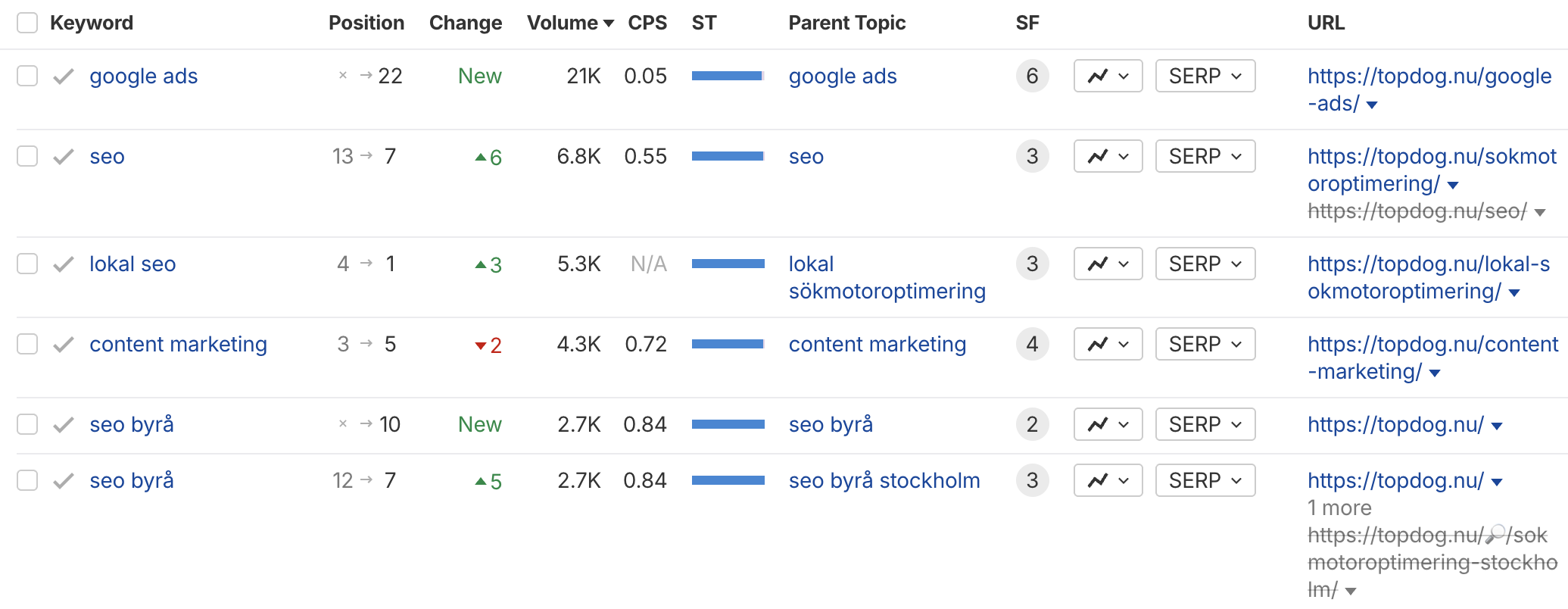
Keywords are the foundation of our quantitative measurement. We start by building clear, comprehensive keyword lists. Then we track them closely, following the site’s rankings for those keywords in an SEO tool such as Ahrefs, Semrush, AccuRanker or Wincher.
We set up tracking URL by URL, not just at domain level. A page that’s meant to rank for a particular topic typically has 10 to 20 keywords attached to it, and we track them as a group. You can then see exactly how that page is performing, and you can link the actions you’ve taken directly to changes in its rankings. The same method also reveals how different types of page react when Google rolls out an update.
2. Visibility across the whole website
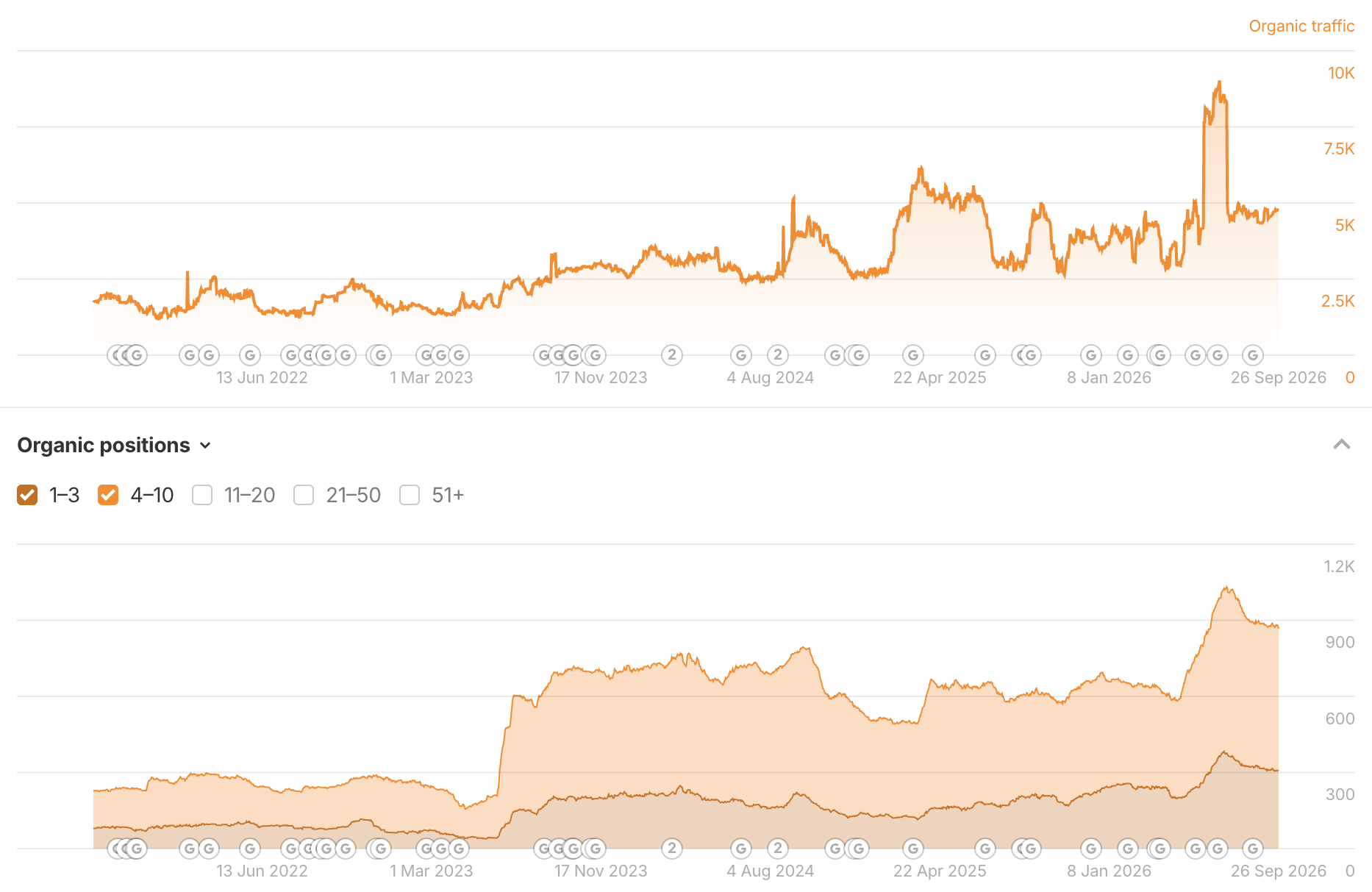
You can’t steer a project by looking at individual pages alone, so Topdog also tracks how the website performs as a whole, using Google Search Console and other external SEO tools. A visibility metric sums up how many searches your site appears for and how high it ranks, so you can follow the whole site’s progress on a single line.
A quick note on terminology: Semrush and Ahrefs use the term “organic traffic” when they measure visibility, and that often causes confusion. Organic traffic isn’t the same thing as visibility. Think of organic traffic as an index of SEO success that moves in step with real traffic trends over the long term.
This overall picture is essential for leading the project and understanding how the site behaves as a whole. Visibility and organic traffic are fairly blunt measures, but they’re valuable precisely because they’re quick to produce. They’re also very good at capturing the long-term traffic trend, regardless of short-term fluctuations. We often add a count of how many top 3 and top 4 to 10 positions a site holds, and how that changes over time, because it gives a more objective view of progress.
This overall picture is essential for leading the project and understanding how the site behaves as a whole.
Another point to bear in mind: Google Analytics 4 (GA4) doesn’t capture all organic traffic, because tracking requires consent and can be blocked by ad blockers. Google Search Console, by contrast, measures clicks directly at Google and isn’t affected in the same way. If clicks in Search Console are steady but GA4 sessions are falling, the cause is usually a tracking error, not a sign that your SEO has stopped working. So we treat Search Console as the primary source for clicks and visibility, and use GA4 to understand what visitors do after they land.
3. KPIs split by brand and non-brand
If you measure organic traffic as one lump, you’re mixing up two entirely different things. A good SEO KPI always separates the two:
| Type of search | What it is | What an increase mainly reflects |
| Brand | Searches containing your company or product name | PR, awareness, previous customer contact |
| Non-brand (generic) | Searches for a service or problem where the customer hasn’t yet chosen a supplier | Your SEO work and new rankings |
The trend in non-brand traffic shows whether your SEO is reaching new customers. If only brand searches are rising, PR or other marketing could just as easily be behind it, and not necessarily your SEO work.
4. Conversion
Conversion rate shows whether your SEO is paying off. Rankings and traffic show that people are finding the site. Only conversion rate tells you whether those visits contributed to your business. A conversion might be a quote request, a purchase, a booking or a phone call, and what counts varies from one business to the next.
That’s why it’s worth defining exactly what a conversion means in your business. Usually there are one or two main goals, such as a purchase or an enquiry. Alongside them sit a few secondary goals that show a visitor is getting closer to becoming a customer, such as a click on your phone number or a form someone has begun to fill in.
Google Analytics is the most common way to track conversion. We follow organic traffic from landing page through to conversion. We measure conversion rate per page and split it into brand and non-brand, just as we do for traffic. That shows you which pages and keywords really bring in customers, and how organic search compares with your other channels.
Measuring conversion also shows you which pages generate business, so you can put more resources where they’ll do the most good. And it shows where you’re losing people. If a page ranks well but converts poorly, the problem usually lies in the content or the layout.
Google Analytics doesn’t capture every visitor, so treat your conversion figures as a guide rather than an exact count. Conversions are also far fewer than clicks, so we need a longer measurement period before we can draw any conclusions.
5. Visibility in AI answers
Points 1 to 4 rest on twenty years of proven methodology. This one is different: it’s a newer metric that we’re still exploring with our clients. We include it anyway, because it can already be measured in concrete terms and we expect it to become more important.
We measure AI visibility by counting how often your brand is cited as a source when AI tools such as ChatGPT, Gemini and Google AI Overviews answer questions in your field. It complements classic rankings, because readers now often get their answer directly in the AI interface and never click through to a website.
This isn’t about replacing traditional measurement. It’s about adding a new dimension. A page can lose clicks as more people get their answer from an AI overview, yet still drive business by being cited as a source and by lifting brand searches.
If you want to start measuring your own visibility in AI answers, the starting point is the same as for classic SEO: a clear baseline, follow-up over time and a sharp line between brand and non-brand signals.
How long does it take before measurement shows results?
SEO rarely delivers results immediately, so expect months rather than weeks. How quickly it happens depends on how competitive your keywords are, where the site is starting from and how much of the plan we manage to carry out.
We never draw conclusions from a single data point. Instead, we follow the trend against a baseline we set before the project begins. It’s also why we measure on two levels: qualitative measurement shows the work moving forward even before rankings have had time to respond.
Read more about how long it takes to see results from your SEO work.
How do we connect measurement to the business?
Rankings and traffic are a means, not the goal. What counts is traffic turning into leads, sales or other business value, and the way to get there is to measure the whole journey from search to conversion.
More traffic without any business impact isn’t success. So alongside rankings and visibility, we track metrics that reflect the commercial side: how much of your traffic converts, which pages and keywords bring in customers, and how the organic channel performs against your other channels. This only works if your conversion tracking and analytics are set up properly. Then you can follow a rising curve in Google all the way to a sale.
That’s how we turn SEO into business value instead of stopping at visibility. We don’t measure SEO to impress you with traffic figures. We do it to show what the work contributes to your bottom line.
What do we do with what we measure?
We treat measurement as feedback from Google on what works. When we make a change and watch how rankings and visibility respond, we learn what moves the needle for each section of your website.
We’ve seen the same pattern in tough sectors such as finance and casino. This feedback loop lets us adjust the strategy mid-project instead of guessing. You’ll find an example of how that looks in practice among our case studies.
Topdog’s view: we measure thoroughly, but we don’t report
Everything you’ve just read about (keywords, visibility, brand and non-brand, AI answers and conversion) is what we measure. It doesn’t tell you how you get to see any of it, though, and that’s where we differ from most agencies.
Rankings and traffic have their place in SEO measurement, but time and again we see the industry stop there. Plenty of agencies send a slick PDF report at the end of the month, full of curves pointing upwards, without ever tying it to what it means for the client’s business. We don’t do that.
We don’t deliver standalone SEO reports in that sense. Measurement is part of an ongoing conversation with you, and it’s rooted in your business from day one. At Topdog, you always work directly with the same expert who handles the analysis, the planning and the implementation, with no project manager or key account manager in between. That leaves no reason to repackage the numbers into a separate report before they reach you. They arrive in the same conversation as the rest of the work, always tied to what they mean for you right now.
That said, we’re not entirely against reports. If you ask, we can build standardised reports and send them to you automatically once a month.
We also believe qualitative measurement matters more than many in the industry seem to think. That means making sure tasks are actually completed and checked. It’s easy to get stuck on numbers and curves and forget to ask whether what was supposed to happen actually did. We call this combination of clarity, follow-up and shared process “execution power”.
Trust is good, control is better.
That’s our motto, and it applies as much to how we check our own work as it does to the SEO results themselves.
Want to know whether your own SEO is working? Contact Topdog and we’ll walk you through what a measurable SEO project would look like for you.
Frequently asked questions about measuring SEO
What is a KPI in SEO?
A KPI (key performance indicator) is a metric that shows whether your search engine optimization is heading in the right direction. Rankings, organic traffic and leads from SEO are typical examples.
If I only have time to follow one SEO metric, which should I choose?
Choose the trend in your non-brand traffic. It shows whether you’re reaching new customers who didn’t already know you. That makes it the most honest single metric.
Which SEO KPIs should you track at different stages?
The priorities shift depending on where you are. On a new or young website, keyword rankings per URL matter most, because they give the first sign that your content is working. On a more established site, the share of non-brand traffic and conversions from organic search become more important. Rankings are already in place, so the question is whether they turn into business.
How often should you measure your SEO?
A practical rule of thumb: check keyword positions and visibility every week to catch big changes early, but only draw real conclusions about the project’s direction monthly or quarterly, against a clear baseline. Reading too much into weekly swings usually leads you astray, because individual data points naturally fluctuate.
Will I get a ready-made SEO report from Topdog?
Not in the traditional sense. We don’t repackage measurement into a standalone report. Instead, follow-up happens continuously with your expert, always tied to what the figures actually mean for your business.
How do you measure visibility in AI answers?
You track how often your brand is cited in AI-generated answers to relevant questions, for example with a tool such as Ahrefs Brand Radar. Keep in mind that this is a newer field than classic SEO measurement. Tools and best practice are still evolving, so treat it as a supplementary metric.


Christian Rudolf
VD och Sökmotorkonsult
Christian has +20 years of experience in SEO and digital marketing. His experience includes challenging sectors such as casino and finance, as well as global markets. What sets Christian apart in SEO is his focus on execution. This is the real challenge in SEO.

 +46 708 140833