

A site migration with almost no margin for error
Fass.se is Sweden’s main source of medicines information, and people depend on what it holds. Healthcare professionals and the public go there to find out how to take a medicine, at what dose and with what risks. A faulty redirect could send users to incorrect information, or to none at all. That made the migration far more than a standard SEO project. The work had to protect visibility in Google and make sure users still found the right medicines information. Over 24 months, four agile development teams in four countries worked alongside an SEO specialist from Topdog.
The challenge
Fass.se is used by healthcare providers, pharmacies, veterinary professionals and the public, and it carries vital details on dosage, side effects and interactions. So we had to keep that information accurate and accessible throughout the migration, not just preserve the site’s visibility in search engines.
The old version of fass.se had built up significant technical debt over many years. Session parameters and dynamic variants of the same pages caused the site to generate around 15 million URLs, and only a tiny fraction had any value for users or search engines. Googlebot made roughly 150,000 page requests a day and reached relevant content in just 2 to 3% of them.
The mobile experience was no better. The site wasn’t mobile-friendly, and Fass ran a completely separate mobile version instead of a single responsive architecture. On top of that, product pages had no structured data.
The biggest risk, however, was the content itself. The migration moved patient information leaflets and medicines information from root URLs into a new subfolder structure. If Google surfaced the wrong page type after a redirect, or a leaflet didn’t migrate correctly, users might miss the right information or misread it. That left far less room for error than in a typical migration, where the odd mistake and a short-term dip in traffic are usually tolerable.
We also had to consolidate or permanently remove some historical medicine pages. Done badly, that risked losing authority and rankings.
The goal
The goal was a technically sound platform built to last, without compromising access to current, quality-assured medicines information.
Topdog therefore focused on five things:
- A new mobile-first website with SEO built into its architecture
- A near-flawless migration of around 15 million URLs
- Protected rankings for Sweden’s most searched-for medicines
- A 95% smaller index, achieved by removing parameter-based duplication
- Redirects that always led to the correct medicines information
The focus wasn’t on chasing new traffic. It was on stability, structure and a platform that could support Sweden’s medicines information for years to come, with the technical debt cleared out once and for all.
Strategy and approach
Fass sets a high bar for who gets to help shape the technical development of its platform.
“FASS has its own internal quality process for technical development. To be part of that work at all, you need a deep understanding of how modern development processes work.”
– Eugene Melnykov, Head of SEO at Topdog
Topdog’s strategy rested on three pillars, designed to handle scale and risk at the same time.
SEO built into the technical architecture
SEO was part of product decisions from day one, not something added afterwards.
That meant:
- A logical, scalable URL structure
- No more session-based parameter duplication
- A single responsive architecture in place of the separate mobile site
- Server-side rendering for Googlebot
- Structured data for medicines (schema markup)
- A metadata framework that could scale to tens of thousands of products
Stabilising the site before migration
Before the migration, we canonicalised high-priority URLs, cleaned out duplicate signals and standardised metadata. We also identified the patient leaflet pages most critical to rankings. That gave Google a clear picture of which pages really mattered before the move even began.
A tightly controlled redirect strategy
Topdog mapped and verified around 15 million parameter-generated URLs, canonical medicine pages and internal system queries, with a particular focus on protecting the key public patient leaflet pages. We also built a detailed risk register, a pre-launch validation process and a clear rollback plan in case anything went wrong at launch.
All of it ran inside the teams’ agile delivery process. That meant sprint planning, documented SEO requirements and regular reviews with product owners and management.
“This is the most complex tech and site migration I’ve worked on in my 20 years as an SEO consultant.”
– Christian Rudolf, SEO consultant and CEO at Topdog
“Our content is critical to our audiences: doctors and patients. That made it essential to have a partner who took technical quality extremely seriously. Topdog is that partner.”
– Anna Wessling, Head of Digital and Data-driven Services at FASS
The results
The migration was stable, and it gave Fass a far stronger technical foundation to build on.
The migration held
- We preserved every critical patient leaflet URL.
- The 100 most searched-for medicines, including Ozempic, Mounjaro, Wegovy, Naproxen and Lergigan, held an average position between 1 and 3.
- Organic visibility varied by less than 10% during the first 30 days.
- The site recorded zero critical 404 errors across the 14-day acceptance period for launch.
- Users got the right information at the right moment.
Far more efficient indexing and crawling
- The index shrank by around 95%.
- Crawl waste fell by 99%. Googlebot used to make 150,000 page requests a day, of which only 2 to 3% were valuable. Today it makes 80,000, and 99% of them are.
- Googlebot now crawls the entire site in 3 to 4 days, down from more than a month.
Better technology and mobile experience
- Structured data coverage rose from 0 to 100%.
- Mobile usability errors disappeared entirely.
- A single responsive architecture replaced the fragmented mobile experience.
AI search visibility grew many times over
Fass’s visibility has also grown sharply in AI-driven search experiences such as Google AI Mode. That’s a direct result of a clear site structure, clean technology and complete structured data.
How FASS has grown in Google AI Mode
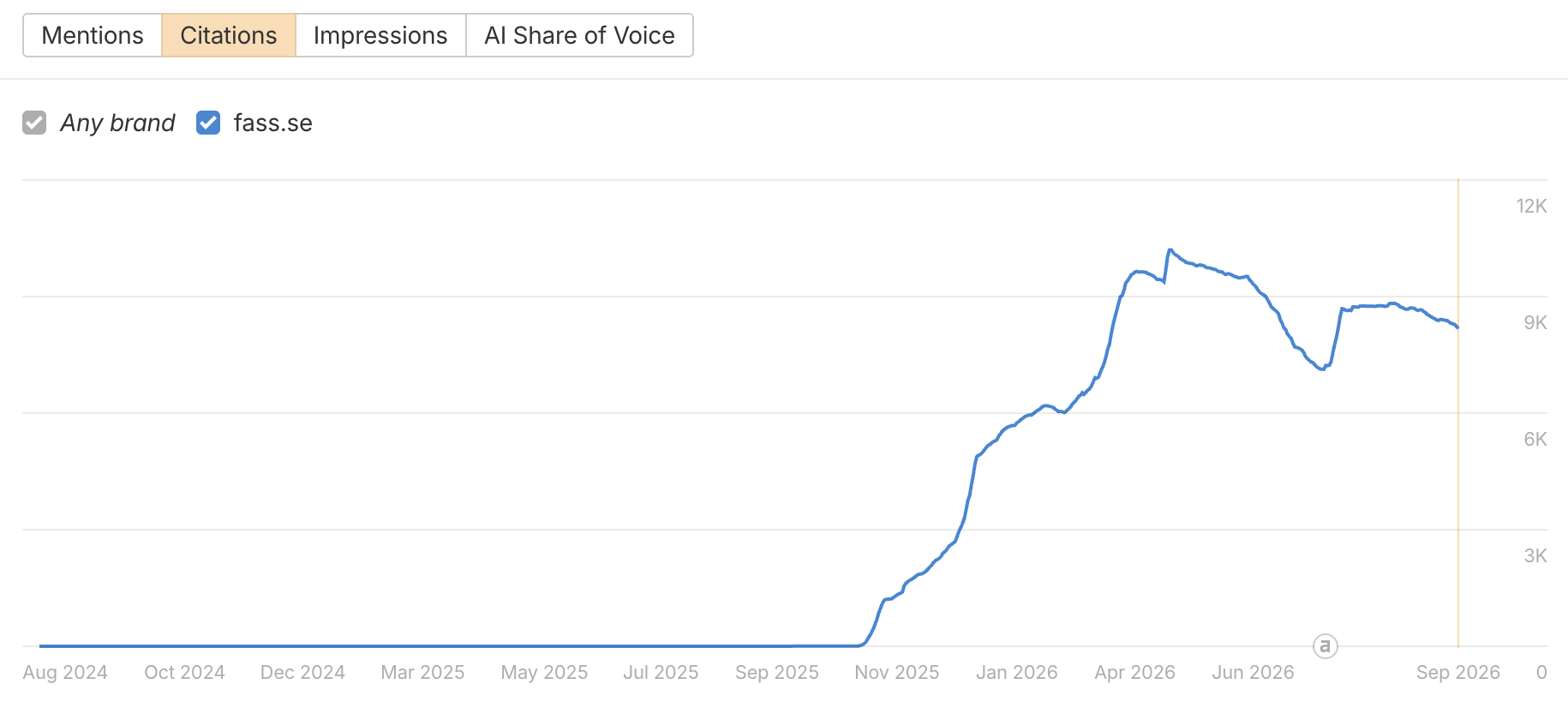
AI citations of fass.se have risen sharply since autumn 2025, from close to zero to around 9,000 a month in autumn 2026, according to Ahrefs Brand Radar.
Fass now runs its website on a simpler, scalable and cleaner technical foundation. It is built to give healthcare providers, pharmacies, veterinary professionals and the public reliable access to medicines information, today and in the future.
Because SEO was part of the architecture from the start, not an add-on, we could rebuild the platform from the ground up, preserve the priority patient leaflets and medicine pages, and track them after launch.


