





Do you need help with local search engine optimization?
-
 Contact us
Get in touch to find out more about local search optimization.
-
 Meeting
We book a meeting to talk through how we can help.
-
 Analysis
We run an analysis tailored to your specific situation.
-
 Quotation
We send you a project and cost proposal.
Local SEO, or local search engine optimization, is about being visible in geographically relevant searches – so that when someone searches for “Business lawyer Stockholm”, “Electrician Nacka” or “removal firm Malmö”, you are the obvious choice on the screen. At Topdog we combine traditional local SEO, scalable landing pages and AI-driven content generation to help Swedish companies rank – from a single location to all 290 of Sweden’s municipalities, and internationally too.
What is local SEO, and how do you succeed at it?
Local SEO has three components: organic rankings, local map-pack results, and AI answers in ChatGPT, Perplexity and Google AI Overviews.
How to succeed with local SEO
To succeed with local search optimization at scale – where you may need to rank across hundreds of municipalities or districts – focus on three things:
- Automation: Building hundreds of local pages by hand simply takes too long. To scale efficiently, you need technical automation and content automation (AI). In SEO terms, this is called programmatic SEO.
- Conversion: Local searches usually stem from a concrete need, which makes them commercially valuable. Your local landing pages therefore need a strong user experience (UX) that makes it effortless for the customer to convert.
- Internal linking: When you create many similar pages for different locations, strong, well-structured internal linking is the single biggest driver of rankings across the whole section.
Why do local SEO?
According to Google, around 40% of all searches have a geographic component – such as “pizzeria Uppsala” in the example above. These searches tend to be highly commercial: the user is close to buying and is simply looking for somewhere to spend their money.
Local search matters most when you are somewhere unfamiliar. In those moments, local Google searches become the basis for the decisions you make.
Local searches also play a big part in voice search. When you are out and about and start to feel hungry, you might ask your phone for a “pizzeria near me”. Google tells you where the nearest one is and will even guide you there if you like. Naturally, you want to be the option Google sends those visitors to.
Who needs local search optimization?
Local search optimization matters most to two types of company: large organisations with a physical presence across the whole country, such as retailers, and local operators – particularly service businesses such as lawyers, restaurants and funeral directors.
Examples of large companies with a nationwide physical presence:
- Banks
- Estate agents
- Funeral directors
- Restaurant chains such as Max or McDonald’s
- Care homes
- Car washes
- Grocery shops such as Ica
- Security companies such as Securitas
Examples of local operators:
- Local restaurants
- Hairdressers
- Grocery shops
- Dentists
- Cafés
- Tradespeople
How Topdog does local SEO in 2026
The big challenge in search engine optimization at the local level is to create a large number of landing pages that are valuable and feel genuinely unique – to Google and to the user alike. Picture a company that operates in all 290 of Sweden’s municipalities. Each one needs its own landing page built around local keywords. But the challenge is not just creating them; they have to be created the right way. Get it wrong, and Google may read it as content spam and drop the pages from its index.
So what does “right” mean from Google’s perspective?
Every local landing page needs clear local value and has to feel genuinely unique. Some of the key elements are:
- A unique introduction for each town or location
- Authentic images from the local area
- Local reviews and customer cases
- References to local circumstances that are relevant to the user
- Clear local relevance in the copy and the metadata
- Content that demonstrates experience, credibility and local knowledge (Google calls this EEAT)
Google wants to see that the page is genuinely relevant to that specific location – not just a copy with the place name swapped out.
Google Business Profile and local SEO
Alongside landing pages, Google Business Profile (formerly Google My Business) is central to local SEO. It is often a company’s most important asset for showing up in Google’s local results and on Google Maps. Yet many companies have issues that hold their visibility back, for example:
- Incorrect or inconsistent business information
- Duplicate profiles
- Poorly chosen categories and services
- Too few or irrelevant reviews
- A lack of local images and updates
- Suspended profiles or verification issues
- A weak link between the website and the Google profile
To succeed at local SEO, the website and the Google Business Profile need to work together and send Google clear local relevance signals.
This often makes for very labour-intensive web projects. What is more, you have to get it exactly right, because the pages are bound to be fairly similar to one another. Without the right structure and the right delivery process, all sorts of errors creep in – and they cost you when it comes to ranking in the search engine.
Topdog’s process for local search engine optimization
Because SEO projects are fairly complex, Topdog uses a two-part process, or strategy, for local SEO:
- Planning the work across technology, content, user experience and links. In this phase, we also build understanding within your organisation of why the work is needed.
- Carrying out the work.
Below is a diagram describing the process for delivering local SEO:
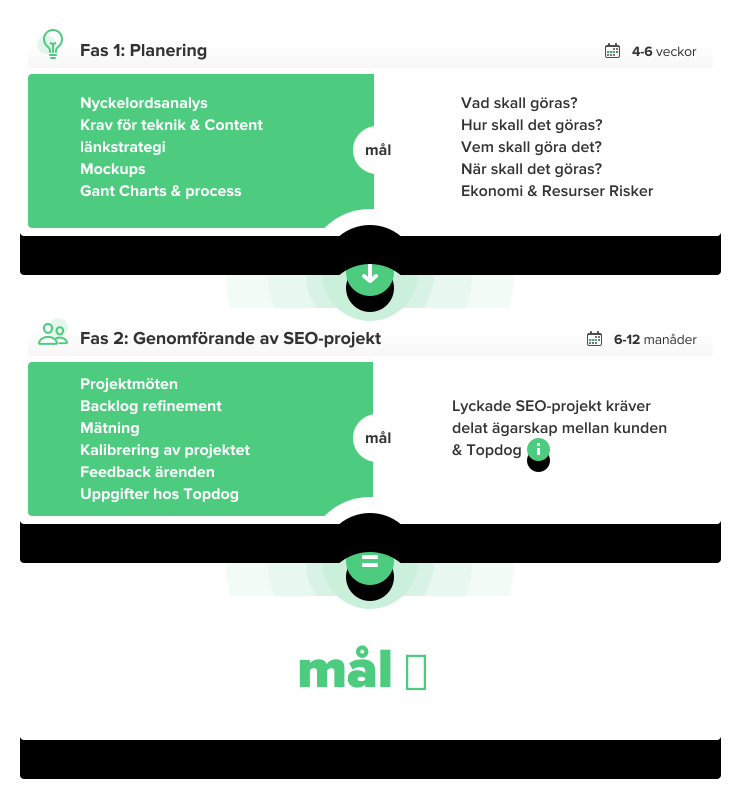 A high-level view of Topdog’s process for local SEO.
1. Planning a local SEO project
A planning project in local SEO should answer a series of questions across each of the four areas – content, technology, user experience and links:
- What needs to be done?
- Who will do it?
- How will it be done?
- When will it be done?
- Finances and risks
The company’s management also needs to understand the project, and there are almost always a few decisions that only management can make to get the SEO project off the ground.
2. Carrying out a local SEO project
Once everything is planned and the decisions are made, it is time to do the work. As a rule, Topdog’s clients want us to share responsibility for delivery, alongside a project manager on the client side.
During the planning phase, we agree exactly how we will run the project together with the client. Topdog prefers to deliver the SEO project using the client’s own resources as far as possible.
A typical delivery cycle:
- A project group meets and reviews what is to be done over the next two weeks. Topdog leads the group’s work.
- Over the following 2–3 weeks, the client implements the improvements we have agreed.
- Topdog makes sure they are done correctly and supports the client throughout.
- The improvements go live on the website.
- Topdog measures and calibrates the project so it stays on plan.
An example of successful local SEO delivered by Topdog
Below is a case from the USA that Topdog led. The fast, dramatic result comes down to the fact that, in this project, many thousands of landing pages were launched at once. So the work was mostly technology, UX and delivery, with relatively little content – a reflection of the particular type of organisation the client has.
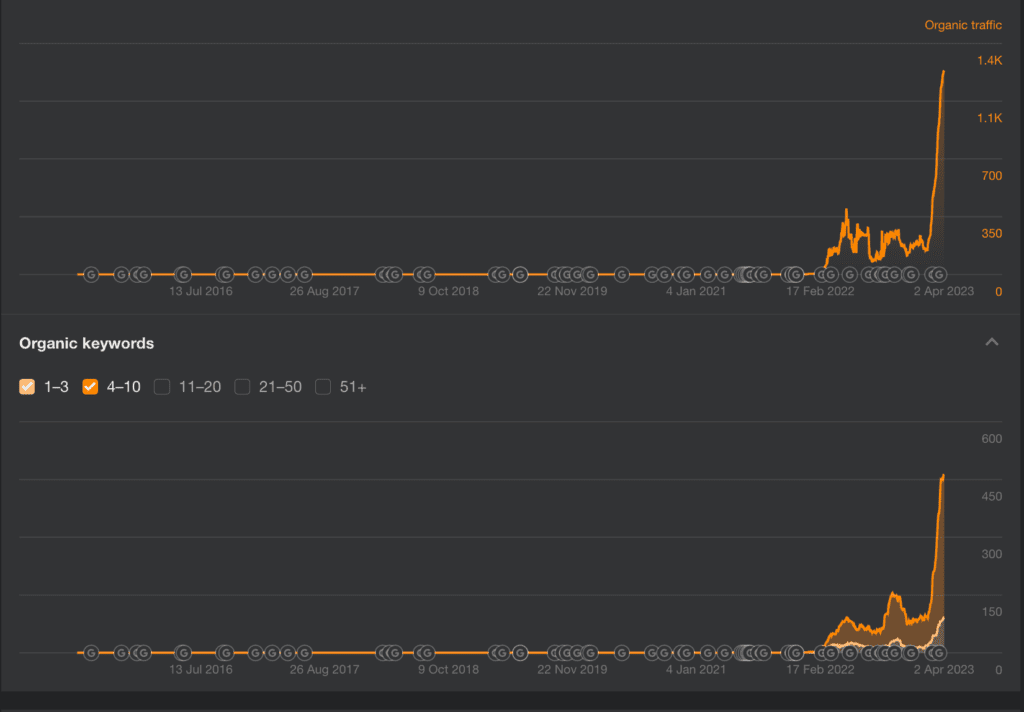 The data shows how a local part of a website grows within Google’s index.
Local SEO and AI – how to show up in ChatGPT, Perplexity and Google AI Overviews
In 2026, local SEO is no longer just about Google. When someone asks ChatGPT for the “best lunch in Vasastan”, asks Perplexity “which plumber is recommended in Sundsvall”, or gets a Google AI Overview after searching for “lawyer in Linköping”, it is signals beyond traditional SEO that decide whether your company gets mentioned. Ranking on page 1 of Google is not enough when the AI has already answered the question for the user, above the search results.
The four platforms that drive local AI answers
Local AI answers are generated today on four main platforms, each with its own logic:
- Google AI Overviews and AI Mode – use Google’s ordinary index plus a reasoning model. Classic SEO, schema and E-E-A-T decide which sources get cited.
- ChatGPT (OpenAI) – uses live search via Bing as well as its training data. Without a correct setup in Bing Webmaster Tools, you are invisible in ChatGPT.
- Perplexity – citation-heavy, and it rewards clearly structured answers. A direct answer in the first sentence after an H2 is often picked up as a source.
- Claude (Anthropic) and Gemini (Google) – pull information via their own web search and draw on the model’s training data. Consistent brand mentions across the open web (Wikipedia, Wikidata, industry publications) are what get noticed over time.
What does it take to show up in local AI answers?
AI systems extract and cite based on three factors that matter far more here than they do for traditional search:
1. Technical clarity and schema. AI crawlers (GPTBot, ClaudeBot, PerplexityBot) handle JavaScript less well than Googlebot and time out sooner. The page’s content has to be present in the initial HTML source. Schema markup must validate: Organisation with sameAs to Wikipedia/LinkedIn, LocalBusiness or Service with geocoordinates, FAQPage for common questions, and Article with datePublished and dateModified.
2. Content that answers questions. The first sentence after each H2 should be a direct, self-contained answer to the question the heading poses. The AI extracts this sentence first – if it is vague or salesy, it will not be cited. Concrete figures (“40% of searches have a local component”) beat woolly phrasing (“many searches are local”) every time.
3. Topical authority beyond the site. LLMs are trained on the open web. Consistent NAP details (Name, Address, Phone) across Google Business Profile, Bing Places, Apple Maps, Hitta.se, Eniro and industry directories build the entity. A presence on Wikipedia or Wikidata (where possible), press mentions and consistent brand usage all help future model versions recognise you.
Topdog’s method for local AI SEO
We work to a three-step process that overlaps with – but does not replace – the traditional local SEO process:
- Analysis of visibility in AI services. We test 30–50 representative local searches across ChatGPT, Perplexity, Google AI Overviews and Gemini to map where you are mentioned today and where competitors own the answer. The output is a scorecard for each platform.
- A technical foundation for AI. We confirm that AI bots are not blocked in robots.txt or in the logs, set up Bing Webmaster Tools, implement LocalBusiness/Service/FAQPage schema, and make sure every local landing page has an answer-ready structure.
- Scalable, AI-driven landing-page generation. For clients with many locations (10–290 municipalities), we build an automated pipeline that generates unique content for each location – with local landmarks, customer reviews from that specific location and factual details from our own data. This differs from generic “programmatic SEO” because every page demonstrably clears both Google’s spam filters and the AI models’ quality thresholds.
- Integration into navigation, the home page and internal links.
Measurability and follow-up
AI SEO optimization is harder to measure than traditional SEO, because AI answers rarely generate clicks. We track four indicators each month:
- AI referral traffic in GA4 – sessions with referrers chatgpt.com, perplexity.ai and gemini.google.com
- Mention rate – a manual review of 30–50 searches per quarter
- Bing Webmaster Tools – clicks and impressions in Bing (a proxy for ChatGPT visibility)
- Branded search – the trend in “rudolf plumber”-type searches in GSC
In short, local SEO for AI is not a separate service – it is an updated version of the same job. The difference is that we optimize to be cited, not just ranked, and that we cover four platforms in parallel rather than just one.
Local SEO is not local domains
Some SEO agencies sell “landing pages”. The agency owns a page about, say, “plumber Kalmar” that ranks well for that term, then sells you a placement on it and recommends you as a client. That is closer to buying ads on aftonbladet.se than to SEO. It is not an SEO method, and it is not one we would recommend.
For one thing, it is really just conventional advertising: you are buying a placement. As an SEO method it is weak, too. The truth is that you would far rather have a user land on your own page and engage properly with your brand and the way you work than land somewhere else and spend their time there. The reason is that today’s customer journeys are fairly complex, and the more time a customer spends with you, the better your odds.
Why choose Topdog for local search engine optimization?
At Topdog we offer:
- Reassuring, clear processes for local SEO
- Clear technical project planning
- An approach tailored to your circumstances
- A genuine interest in you as a client
- Delivery alongside you that gets results
Our services related to local SEO




Our clients









Reviews
 5/5
5/5
“Mex hired Topdog to improve our ranking on commercial keywords and reverse a negative trend in traffic. The project focused on content, technical SEO and improved information structure on about 50 of our converting pages.
Topdog is in our opinion one of the best SEO agencies we have worked with. They combine strategy and execution – from content production and landing pages to technical solutions.
What stands out is their execution power and commercial focus. The work was data-driven and linked to business benefit, not just ranking. In addition, they were very committed.
The result was improved visibility, better structure and we learned a lot about the web during the project.”

Henric Gustafsson
VD
5/5
Topdog has been a great partner in improving our local SEO. Their team is knowledgeable, engaged, and understands what it takes to rank for competitive local searches. Since working with them, we’ve seen a clear improvement in our visibility, leading to more relevant leads and ranking on lower funnel search terms. They are also easy to work with—proactive, responsive, and focused on results.
After working with them on a local project they provided a full site audit that was used to make other SEO updates to improve customer experience and rankings. I have requested input from the Top Dog team multiple times even after the contract was completed and they were more than willing to assist. I would highly recommend them to any business looking to strengthen their local search presence.
Haley Damron
Marketing Director
American Pest
5/5
For us as buyers, it is not always straightforward to make a purchase when you are rarely alone in the decision. As the person placing the order, I have other people around me who are involved in the decision and who need to be won over. Not just initially but also continuously throughout the project. This involved both hard information around business value for management, such as a business case, but also softer information for my colleagues who would be involved in doing the work.
Seen from this perspective, I think Topdog stands out in a remarkably positive way. They have both the understanding and the ability to help deliver what you need to make other decision-makers in the organization feel confident.
Topdog is the agency I return to when I do SEO and content marketing.
Anders Sjöberg
Head of Marketing & Communication
Anticimex
5/5
When you work with Topdog, you notice that they have a genuine joy about SEO and content and a goodwill. Topdog wishes us the best. I can absolutely recommend others to work with Topdog. This applies especially to those who need to anchor SEO in other parts of the organization to make it work. That’s where Topdog is great.
Ruth Länsman
Marknadschef
Ambea
Frequently asked questions about local SEO
-
What is local SEO?
You do local SEO when you want traffic from Google where the user has a specific geographic intent – in other words, when they search for something like "Restaurant Göteborg". Local SEO involves two things: the ordinary organic result, and a three-pack in the local results next to a map.
-
Who does local SEO?
Any company that sells local services – for example restaurants, banks, hairdressers, tradespeople and funeral directors.
-
Why do local search engine optimization?
Around 40% of all searches on Google have a local intent, so there is a great deal of value to be gained from local search engine optimization.
-
What does Topdog's process for local search engine optimization look like?
We use a delivery model built around planning and delivery together with the client, all aimed at reaching the project's goals. We work in an agile way throughout.
-
How does local SEO work?
Local SEO is about optimizing your digital presence so your company shows up when people search for services or products in a specific geographic area – for example "dentist Malmö" or "restaurant Uppsala". You achieve this through a combination of technical SEO, locally tailored content, Google Business Profile, reviews and clear geographic signals on the website. The aim is for Google to understand where you are and which local searches you are relevant for.
-
What does local search engine optimization cost?
Topdog's local SEO projects typically cost between 75,000 and 300,000 SEK. The price varies with competition, the number of locations you want to be visible in, and how much technical and content work is involved. For smaller companies, a smaller local SEO project may be all you need, whereas companies with many geographic areas or fierce competition often need a larger setup.
-
How long does local search optimization take to show results?
Local SEO is often quicker than broad national SEO, but it usually takes between 1 and 4 months before clear results start to show in Google. How fast that happens depends on the level of competition, the website's current state, how much content there is, and how well the improvements are implemented. In some local niches you can see an effect sooner, particularly where competition is low and the website already has a solid technical foundation.
-
What is the difference between local search engine optimization and Google Business Profile?
Google Business Profile is an important part of local SEO, but not the whole job. It helps you appear in Google Maps and local search results, whereas local SEO covers your entire organic visibility in Google. Local SEO also takes in content, technical SEO, local landing pages, internal linking, reviews and how well the website matches users' local search behaviour.
-
How does local SEO work for AI search and ChatGPT?
AI search and services such as ChatGPT are becoming ever more important for local searches. To show up in AI-driven answers, companies need to build clear, credible signals around their business, location and expertise. That includes strong local content, structured data, reviews and consistent information about the company across the web. AI systems often draw on several sources at once, which makes a brand's overall digital presence more important than ever.